Does Medicaid Cover GLP-1 Drugs for Weight Loss? A State-by-State Reality Check
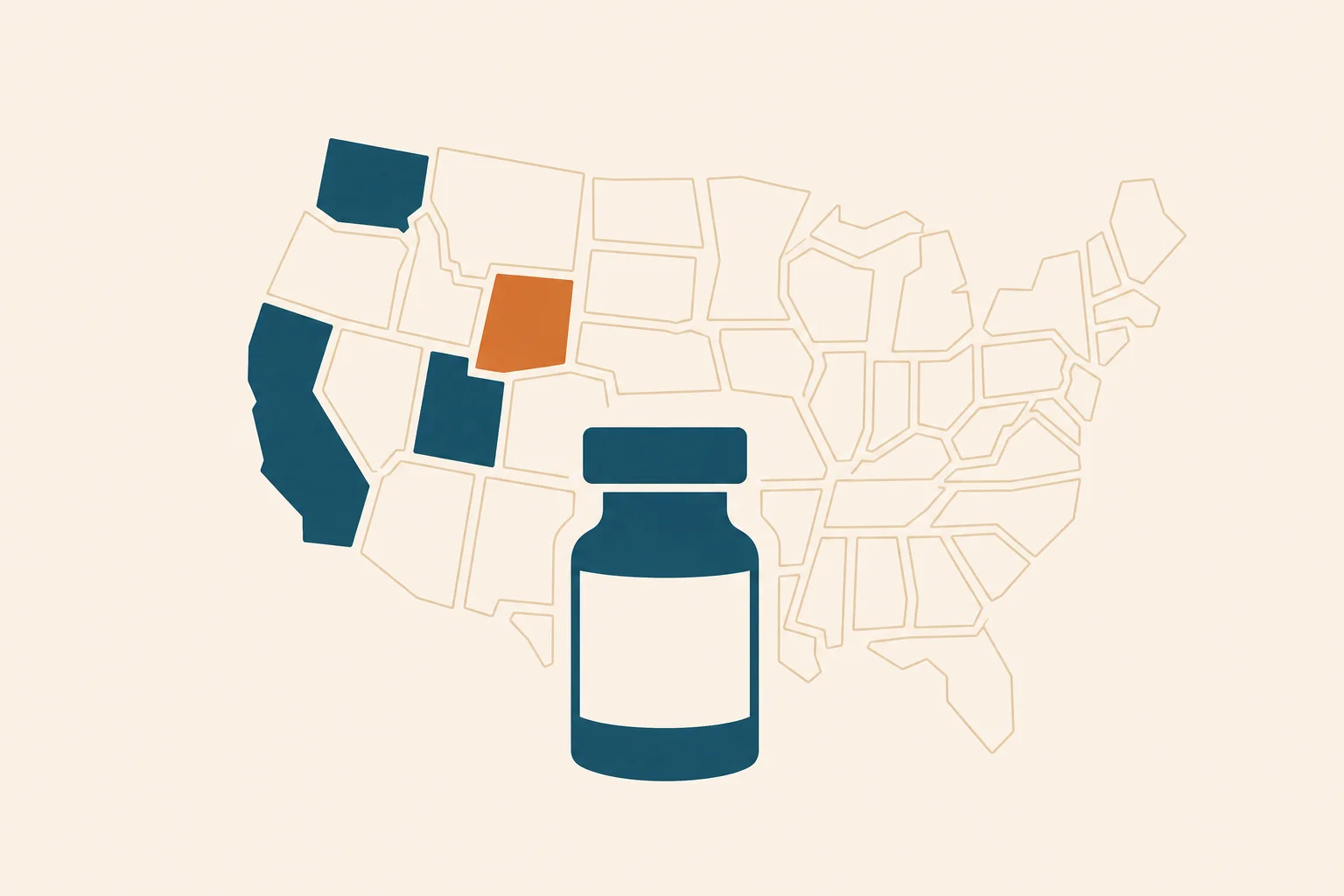
Medicaid coverage for GLP-1 weight-loss drugs is a patchwork of state-by-state decisions, and most states have not covered them for obesity. The picture is clearer for type 2 diabetes — and understanding the difference matters for Medicaid patients trying to access these medications.
The core distinction: obesity vs. T2D indication
GLP-1 drugs are approved for two different uses with different brand names:
- Obesity label (Wegovy, Zepbound): Require a BMI-based obesity diagnosis, not T2D
- T2D label (Ozempic, Mounjaro, Rybelsus, Victoza, Trulicity): Require a T2D diagnosis
Medicaid is a joint federal-state programme that covers T2D treatment in essentially all states — T2D is an established, well-documented chronic condition in Medicaid policy. Obesity as a primary indication for expensive drug therapy is a newer policy question, and most states have not yet made that coverage decision.
States that cover obesity-indicated GLP-1s on Medicaid
As of 2026, approximately 13 states have added Wegovy, Zepbound, or equivalent obesity-indicated GLP-1s to their Medicaid formularies. States with documented coverage include:
- California
- Illinois
- Massachusetts
- New York
- New Mexico
- And several others — the list changes as states update their formularies
States with coverage typically impose prior authorisation, BMI requirements (usually ≥30 or ≥27 with documented comorbidities), and often step therapy requirements similar to commercial insurance.
To check your state's current coverage: The most current source is your state Medicaid agency's formulary search tool, your prescriber's PA team, or KFF's (Kaiser Family Foundation) Medicaid GLP-1 tracker. State formularies update frequently and coverage data from six months ago may be outdated.
States that do not cover obesity-indicated GLP-1s
The majority of states — roughly 37 as of 2026 — do not cover Wegovy, Zepbound, or equivalent obesity-labelled drugs on Medicaid. For these patients:
Path 1: T2D coverage. If you have type 2 diabetes, your state Medicaid almost certainly covers T2D-labelled semaglutide (Ozempic) or tirzepatide (Mounjaro). The T2D indication coverage is present in most state formularies. Your prescriber writes for the T2D indication; the drug's weight-loss effect occurs regardless of which indication is on the prescription. Ask your prescriber whether T2D-labelled prescribing is appropriate for your situation.
Path 2: Self-pay compounded GLP-1. Compounded semaglutide (~$229/month via Eden, $178/month via Mochi) and tirzepatide ($329/month via Eden, ~$278/month via Mochi) are available to self-pay patients. Medicaid status does not affect your ability to purchase these directly from a 503A pharmacy — but you pay entirely out of pocket; Medicaid will not reimburse compounded GLP-1s. These are still cash outlays that many Medicaid-covered patients cannot afford.
Path 3: Advocacy. Several advocacy organisations — including the Obesity Action Coalition and state-level LGBTQ+ health coalitions — are actively pushing states to add GLP-1 obesity coverage to Medicaid. If you believe your state should cover these drugs, your state Medicaid agency and state legislators are the appropriate channels.
What Medicaid patients cannot use
Manufacturer savings programmes are off-limits for Medicaid patients. This is a hard legal constraint:
- NovoCare's Wegovy $349/month flat-rate programme explicitly excludes patients covered by any government programme including Medicaid
- LillyDirect's Zepbound vial programme has the same exclusion
- The Mounjaro and Ozempic savings cards exclude Medicaid, Medicare, and Tricare
- This is not a policy choice by the manufacturers — it is a federal anti-kickback compliance requirement; offering drug discounts to federal healthcare beneficiaries violates 42 U.S.C. § 1320a-7b
Medicaid patients asking their prescriber about these programmes will be told they are ineligible. This is correct.
Dual-eligible patients (Medicare + Medicaid)
Patients enrolled in both Medicare and Medicaid ("dual eligibles") have a different situation. For Medicare:
- Medicare Part D covers T2D GLP-1s
- Medicare GLP-1 Bridge (effective July 1, 2026): covers Zepbound KwikPen at $50/month for qualifying patients with obesity and no T2D requirement — Medicaid will typically cover the Part D premium and cost-sharing for dual eligibles, which may translate to near-zero cost for the drug
If you are dual-eligible, ask your prescriber and your Medicare Part D plan whether you qualify for the Medicare GLP-1 Bridge. The Medicaid side's cost-sharing assistance may apply.
Looking ahead
The CMS (Centers for Medicare and Medicaid Services) has been under pressure from advocacy groups and some states to issue a national GLP-1 coverage policy for Medicaid. As of May 2026, no national Medicaid coverage mandate exists. The Medicare GLP-1 Bridge is an 18-month demonstration on the Medicare side; whether it influences Medicaid policy in the future is an open question.
For the full Medicare GLP-1 coverage picture, see the Medicare GLP-1 coverage guide. For self-pay options, see the cash-pay GLP-1 platform comparison.
Frequently asked questions
Does Medicaid cover Wegovy for weight loss?
It depends on your state. Approximately 13 states cover Wegovy or other obesity-indicated GLP-1s on Medicaid as of 2026. Most state Medicaid programmes do not cover them for obesity — the drug is covered for type 2 diabetes in most states, but the obesity indication requires a separate state policy decision. Check with your state Medicaid programme or your prescriber.
Does Medicaid cover Ozempic for type 2 diabetes?
Yes, in most states. Ozempic (semaglutide) is covered by most state Medicaid programmes for type 2 diabetes, though formulary tier and prior authorisation requirements vary by state. Medicaid patients with T2D who are prescribed Ozempic for glycaemic control should ask their prescriber about the state formulary and any step therapy requirements.
Can Medicaid patients use the NovoCare or LillyDirect savings programmes?
No. The NovoCare Wegovy $349/month flat rate and the LillyDirect Zepbound $299–449/month vial programme are available to patients paying out of pocket — but they explicitly exclude patients covered by any federal healthcare programme, including Medicaid, Medicare, and Tricare. Medicaid patients cannot use manufacturer savings cards or direct-pay programmes. This is a federal anti-kickback compliance requirement.
What are my options if my state Medicaid doesn't cover GLP-1s for obesity?
Options include: (1) If you have T2D, Medicaid may cover the T2D-labelled drugs (Ozempic, Mounjaro) — ask your prescriber; (2) Compounded semaglutide from a 503A pharmacy (~$229/month via Eden, ~$178/month via Mochi) is available to self-pay patients regardless of Medicaid status, though you would pay fully out of pocket; (3) Advocacy — contact your state Medicaid agency and your state legislators if you believe coverage should be added.
Does the Medicare GLP-1 Bridge affect Medicaid patients?
The Medicare GLP-1 Bridge (effective July 1, 2026, Zepbound KwikPen at $50/month for qualifying obesity patients) applies to Medicare, not Medicaid. Dual-eligible patients (enrolled in both Medicare and Medicaid) may benefit from the Medicare GLP-1 Bridge on the Medicare side. Pure Medicaid patients are not affected by the Medicare programme.