Zepbound Cost: LillyDirect, Insurance, and the Cash-Pay Tier (2026)
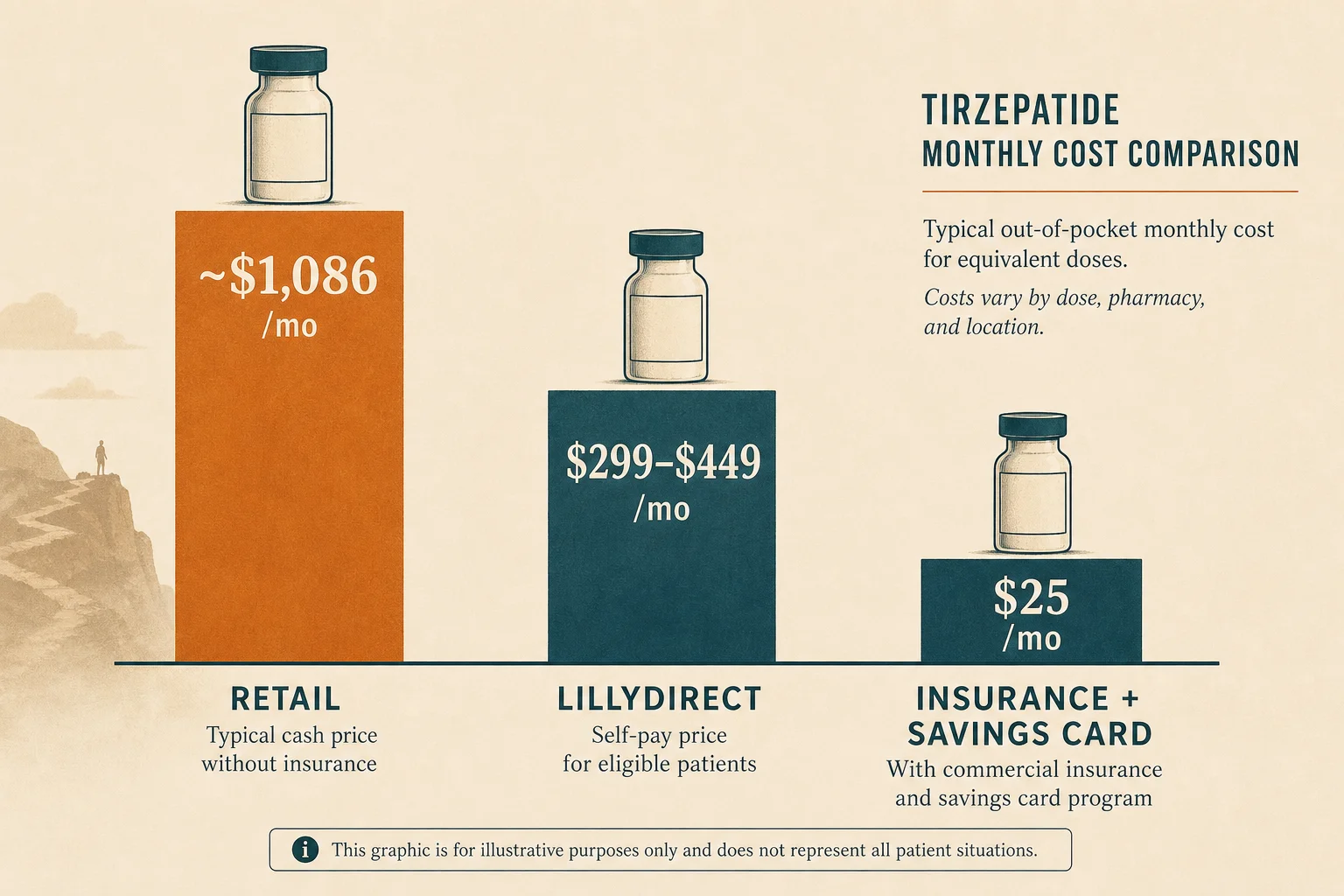
In December 2025, Eli Lilly cut the cash price of every Zepbound vial dose. In February 2026, it extended the same tier to its KwikPen. The Zepbound cost map in May 2026 looks very different from the one that drove the compounded market in 2024: a flat manufacturer cash-pay tier, a savings-card path for commercial insurance, and beginning July 1 a Medicare door that did not exist a year ago.
This is the dated price map, sourced.
The headline May 2026 prices
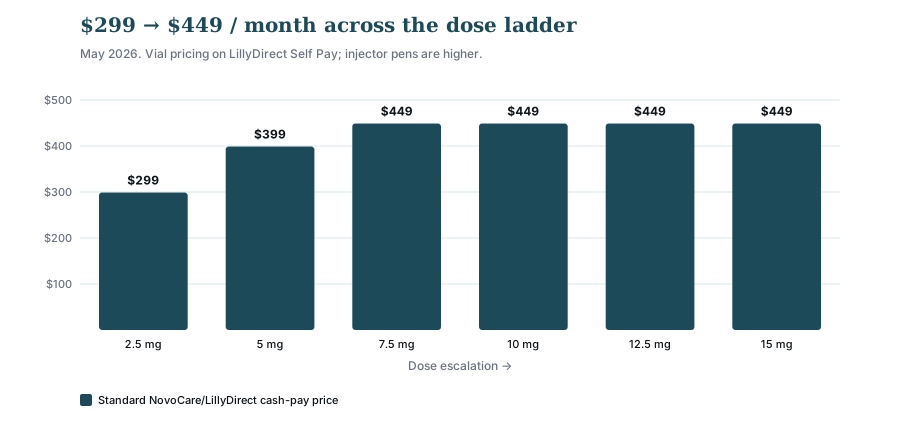
On December 1, 2025, Lilly cut LillyDirect Self Pay prices for the Zepbound single-dose vial to $299 per month for the 2.5 mg starter, $399 per month for 5 mg, and $449 per month for the 7.5, 10, 12.5, and 15 mg doses (Lilly press release; CNBC). The previous tier was $349/$499. The KwikPen lagged at higher cash-pay pricing through most of 2025; on February 23, 2026 Lilly extended the same $299/$399/$449 tier to the KwikPen (Lilly media statement). At the LillyDirect counter the vial-versus-pen price gap is now closed; the choice between formats is clinical, not financial.
List price, the figure on a pharmacy benefit manager’s claim before any rebate or savings card, is approximately $1,086 for a 28-day supply at any dose (Lilly pricing info).
LillyDirect vials vs Zepbound pen
Both formats deliver the same molecule, tirzepatide, at the same six FDA-approved doses (2.5, 5, 7.5, 10, 12.5, and 15 mg weekly). The KwikPen is a multi-dose pre-filled auto-injector. The vial requires the patient to draw the medication into a syringe before injecting. Lilly also offers a single-dose pen (separate from the KwikPen), which is the standard form at commercial pharmacies.
Lilly launched the vial format on LillyDirect in August 2024 as a lower-cost cash-pay alternative (PharmExec). With the KwikPen now at the same cash-pay tier as of February 2026, the question for new patients is comfort handling a syringe rather than cost. A notable logistical addition: as of October 2025, LillyDirect partnered with Walmart to offer in-store pickup at participating Walmart pharmacies nationwide, at the same $299/$399/$449 pricing as home delivery — a useful option for patients who prefer not to wait for mail delivery.
The LillyDirect Self Pay program
Eligibility tracks the FDA-approved Zepbound indication: adults with a BMI of 30 or higher, or a BMI of 27 or higher with at least one weight-related comorbidity (type 2 diabetes, hypertension, dyslipidemia, obstructive sleep apnea, cardiovascular disease). A valid US prescription is required; LillyDirect does not prescribe.
The order flow: a US-licensed provider sends the prescription to LillyDirect, the patient pays online, the medication ships to a US address. No insurance card, no prior authorization. To hold the $449 ceiling on the 7.5, 10, 12.5, and 15 mg doses, refills must be completed within 45 days of the previous delivery (Self Pay Journey Program terms). The 2.5 mg and 5 mg tiers do not carry the 45-day rule. The full step-by-step LillyDirect Zepbound enrollment walkthrough covers the sign-up process in detail.
Insurance pathways
Commercial insurance is the most common path to Zepbound below LillyDirect cost — if your plan covers it. Coverage is uneven. Roughly 43–45% of US commercial plans covered Zepbound for the weight-loss indication as of late 2025, with employer-plan coverage running closer to 55% post-PA at large employers (Zepbound access & coverage). Zepbound’s commercial coverage footprint is broader than Wegovy’s as of mid-2026.
Almost every covering plan requires prior authorization. Typical PA criteria: documented BMI at the FDA-approved threshold, documented comorbidities if BMI is 27–30, evidence of a structured lifestyle program, sometimes a prior trial of another anti-obesity medication. Many large insurers are tightening, not loosening, GLP-1 coverage for 2026–2027, and some have signalled they will not grandfather existing PAs at group anniversary.
Medicare is the other 2026 change. Historically CMS has not covered GLP-1s for obesity alone under Part D, citing the statutory exclusion for weight-loss drugs. The Medicare GLP-1 Bridge demonstration took effect July 1, 2026 and runs through December 31, 2027 (CMS Medicare GLP-1 Bridge; KFF analysis). Eligible Part D beneficiaries (BMI 35+ alone, or BMI 27+ with clinical criteria) can access the Zepbound KwikPen for a $50 copay per 30-day supply. The Bridge covers only the KwikPen, not the single-dose vial or single-dose pen.
The Zepbound savings card
Lilly’s manufacturer savings card is the route a commercially-insured patient with covered Zepbound uses to bring their copay down. The standard offer for the single-dose pen is $25 for up to a 3-month prescription, with a maximum of $1,300 in savings per calendar year (Zepbound savings page).
If your commercial plan does not cover Zepbound, the savings card cannot bridge the gap to $25; it instead routes eligible patients to LillyDirect Self Pay at $299/$399/$449. The card cannot be combined with any other discount, coupon, or assistance program, and is unavailable to Medicare, Medicaid, VA, and TRICARE beneficiaries.
One important note on Lilly’s savings card terms page: as of May 2026, Lilly separately lists a $499/month self-pay rate for commercially insured patients whose plans don’t cover Zepbound through standard channels (distinct from LillyDirect Self Pay). For most cash-pay patients the LillyDirect route at $299/$399/$449 is the better path. Confirm current terms at zepbound.lilly.com/coverage-savings before filling.
Zepbound vs Wegovy on cost
The price gap between brand Zepbound and brand Wegovy has effectively closed. Both manufacturers now run direct-to-consumer cash-pay programs in the same range:
- Zepbound (LillyDirect Self Pay): $299 for 2.5 mg, $399 for 5 mg, $449 for 7.5–15 mg with refills inside 45 days ($499 for 7.5 mg and $699 for 10–15 mg otherwise). Vial or KwikPen.
- Wegovy (NovoCare Pharmacy): $349/month flat, with a $199/month introductory rate for the two lowest doses.
We cover the Wegovy detail in Wegovy cost without insurance. Cost is no longer the deciding factor between the two molecules; clinical fit, side-effect profile, and prescriber preference do more work in 2026 than the price tag. For a full efficacy comparison, see our tirzepatide vs semaglutide breakdown. If neither brand price works for your budget, our cheap GLP-1 alternatives guide covers the remaining options.
The compounded path, and why it is mostly closed
A year ago this section would have been longer. Compounded tirzepatide from a telehealth provider commonly ran $199–$299 a month and was a meaningful share of US tirzepatide volume. FDA declared the tirzepatide shortage resolved on October 2, 2024 and all enforcement-discretion windows for 503A and 503B compounders ended by March 19, 2025. A narrow personalized-need pathway under FDC Act §503A(b)(1)(D) remains contested. The full dated timeline is on our compounding cliff page.
At the dose-escalation point
Zepbound’s prescribing label escalates patients through six dose strengths over months: 2.5 mg (starter, 4 weeks) → 5 mg → 7.5 mg → 10 mg → 12.5 mg → 15 mg. The LillyDirect cash-pay tier maps onto that escalation:
| Dose | LillyDirect / month | Note |
|---|---|---|
| 2.5 mg | $299/month | Starter, typically 4 weeks |
| 5 mg | $399/month | First maintenance candidate for some patients |
| 7.5 mg | $449/month | First month at the $449 ceiling |
| 10 mg | $449/month | Common maintenance dose |
| 12.5 mg | $449/month | Pre-maximum |
| 15 mg | $449/month | FDA-approved maximum |
The price step that matters is 5 mg to 7.5 mg. If you are titrating up and the next dose change is not driven by the lower dose having stopped working, it is worth asking your prescriber whether you can hold at 5 mg for an additional cycle. (Not medical advice; talk to your prescriber.)
What to ask before paying cash
Four questions for your prescriber before the first LillyDirect charge:
- Has my insurance been checked for Zepbound coverage? A pharmacy benefits check before going cash-pay can find an unused covered benefit. See our guide on how to get a GLP-1 prescription for the process from first appointment to filled Rx.
- If my plan does not cover Zepbound, does it cover Wegovy? Coverage is often uneven between the two drugs.
- Can I commit to the refill cadence? The $449 tier on 7.5+ mg doses requires refills within 45 days.
- Pen or vial? The tier is the same either way; the question is whether you can handle a syringe.
What patients are actually paying: Reddit cost experiences
Three themes recur in tirzepatide cost discussions across r/tirzepatide and r/Ozempic in 2025–2026.
Switching to Zepbound from Wegovy for cost reasons. A widely-read r/Semaglutide thread included a commenter who described moving from Wegovy to Zepbound specifically for the price: "I switched to Zepbound, but I paid $460/month for Wegovy for over a year." They were in Canada, where access programs differ, but the sentiment — that Zepbound's pricing structure can undercut Wegovy when both are being paid out of pocket — maps to the US cash-pay picture, where Zepbound's $299 starter is $50 below Wegovy's $349 flat rate.
The $50 step at 7.5 mg shapes real decisions. Multiple patients in cost threads flag the 5 mg to 7.5 mg price increase — from $399 to $449 — as a meaningful monthly decision point, especially for patients doing well at 5 mg. The question "Is the next dose worth $50 more a month?" comes up regularly, and the answer is usually framed clinically (is the lower dose still working?) rather than financially (the $50 difference rarely drives a clinical decision). But it is a line item patients notice and factor into budget conversations.
Insurance denial and the cash-pay safety net. The cost frustration in r/Semaglutide and r/Ozempic threads consistently returns to the same theme: plans that cover Zepbound for some indications (sleep apnea, type 2 diabetes) but not for weight management alone create uneven access. "So basically this med could help us not become diabetic but they literally only want to cover it when we get diabetic," one commenter summarised. For patients in that coverage gap, LillyDirect Self Pay at $299–$449 is the practical floor.
How we keep this article current
We refresh this page on every Lilly pricing announcement, every formulary change to the Medicare GLP-1 Bridge, and every material change to the manufacturer savings card terms. Three things move faster than the rest:
- Pricing. Lilly cut LillyDirect cash prices twice in twelve months — on December 1, 2025 (vial cut to $299/$399/$449) and on February 23, 2026 (KwikPen extended to the same tier). Further reductions are plausible. The Trump administration's October 2025 framework agreement with Lilly and Novo Nordisk on GLP-1 pricing also points to downward pressure on list prices through Medicare and Medicaid channels into 2027.
- The Medicare GLP-1 Bridge. It is a demonstration with a hard end date of December 31, 2027, and the only Zepbound formulation included is the KwikPen.
- Manufacturer savings card terms. Lilly revises card eligibility and caps periodically; we re-verify on each change.
If you spot an error or a missing source, please email [email protected]. Our methodology and editorial policy explain how we source, who reviews each page, and the conflicts of interest we disclose. We do not sell Zepbound or earn a commission on LillyDirect orders.
Frequently asked questions
How much does Zepbound cost per month in May 2026?
Through LillyDirect Self Pay, $299 for the 2.5 mg starter, $399 for 5 mg, and $449 for the 7.5, 10, 12.5, and 15 mg doses as long as each refill is bought within 45 days of the last delivery (otherwise $499 for 7.5 mg and $699 for 10, 12.5, and 15 mg) — same tier for vial or KwikPen. With commercial insurance that covers Zepbound, the manufacturer savings card can bring the copay to $25 for up to a 3-month prescription, with $1,300 maximum annual savings. List price without either route is roughly $1,086 for a 28-day supply.
What's the difference between Zepbound vials and the KwikPen?
Same drug, same FDA approval, same doses. The vial requires you to draw the dose into a syringe yourself; the KwikPen is a pre-filled multi-dose injector. Lilly launched the vial channel in August 2024 as a lower-cost alternative to the pen, and on February 23, 2026 extended the same $299/$399/$449 tier to the KwikPen through LillyDirect.
Who is eligible for the LillyDirect Self Pay program?
Adults with a valid US prescription for the FDA-approved indication: BMI of 30+, or BMI 27+ with at least one weight-related comorbidity (type 2 diabetes, hypertension, dyslipidemia). Zepbound is also FDA-approved for moderate-to-severe obstructive sleep apnea in adults with obesity. To hold the $449 ceiling on doses 7.5 mg and above, complete each refill within 45 days of the previous delivery.
Does the Zepbound savings card work if I'm uninsured?
Only partially. The $25-for-up-to-3-months copay version of the card is for commercially-insured patients whose plan covers Zepbound. If your commercial plan does not cover Zepbound, the card routes you to LillyDirect Self Pay pricing instead. The card excludes Medicare, Medicaid, VA, and TRICARE beneficiaries by statute.
Does Medicare cover Zepbound?
Conditionally and recently. CMS's Medicare GLP-1 Bridge demonstration took effect July 1, 2026 and runs through December 31, 2027. Eligible Part D beneficiaries (BMI 35+ alone, or BMI 27+ with clinical criteria) can access the Zepbound KwikPen — not the single-dose vial — for a $50 copay per 30-day supply. Standard Part D coverage for Zepbound for moderate-to-severe OSA in adults with obesity has been available since 2024.
How does Zepbound cost compare with Wegovy?
Both run direct-to-consumer cash-pay programs in the same range. Zepbound's LillyDirect Self Pay is $299/$399/$449 (the $449 tier needs refills within 45 days). Wegovy's NovoCare Pharmacy is $349/month flat, with a $199/month introductory rate for the two lowest doses. The pricing is close enough that cost is rarely the deciding factor; clinical fit and prescriber preference do more work.
Can I still get compounded tirzepatide instead?
Mostly no, as of May 2026. FDA declared the tirzepatide shortage resolved on October 2, 2024 and all enforcement-discretion windows for 503A and 503B compounders ended by March 19, 2025. A narrow personalized-need exception under §503A(b)(1)(D) remains contested. The compounding cliff article walks the dates.