FDA, Hims, and Novo: A Plain-English Timeline of the 2026 GLP-1 Compounding Cliff

If you are reading this with a refill of compounded semaglutide on your kitchen counter, the rules that produced it have changed. Twice. The mass-market window that let Hims sell “personalised semaglutide” for $199/month in 2024 closed across 2025, and on April 30, 2026 FDA proposed to nail it shut for good.
This is the timeline, sourced. We will tell you what was happening when, what the legal pathway each side was using, and where the still-open doors are as of May 2026.
Why this matters
For roughly two years, US patients could buy compounded versions of two of the most effective weight-loss drugs ever approved — semaglutide (the active ingredient in Wegovy and Ozempic) and tirzepatide (Zepbound and Mounjaro) — for a fraction of the manufacturer’s list price. That market existed because the FDA had declared both drugs in shortage, and federal law (the Federal Food, Drug, and Cosmetic Act §§503A and 503B) permits compounding pharmacies to make copies of an FDA-approved drug while it is on the shortage list. For a plain-English explanation of the two frameworks, see 503A vs 503B compounding.
The compounded market is now mostly gone, but not entirely. The remaining sliver runs on a clinical-need exception that the FDA, Novo Nordisk, and Eli Lilly are actively trying to close. If you are choosing between a brand-name prescription and a compounded one in 2026, the question you actually need answered is which legal pathway your provider is using and how durable that pathway is.
2022–2024: The shortage years
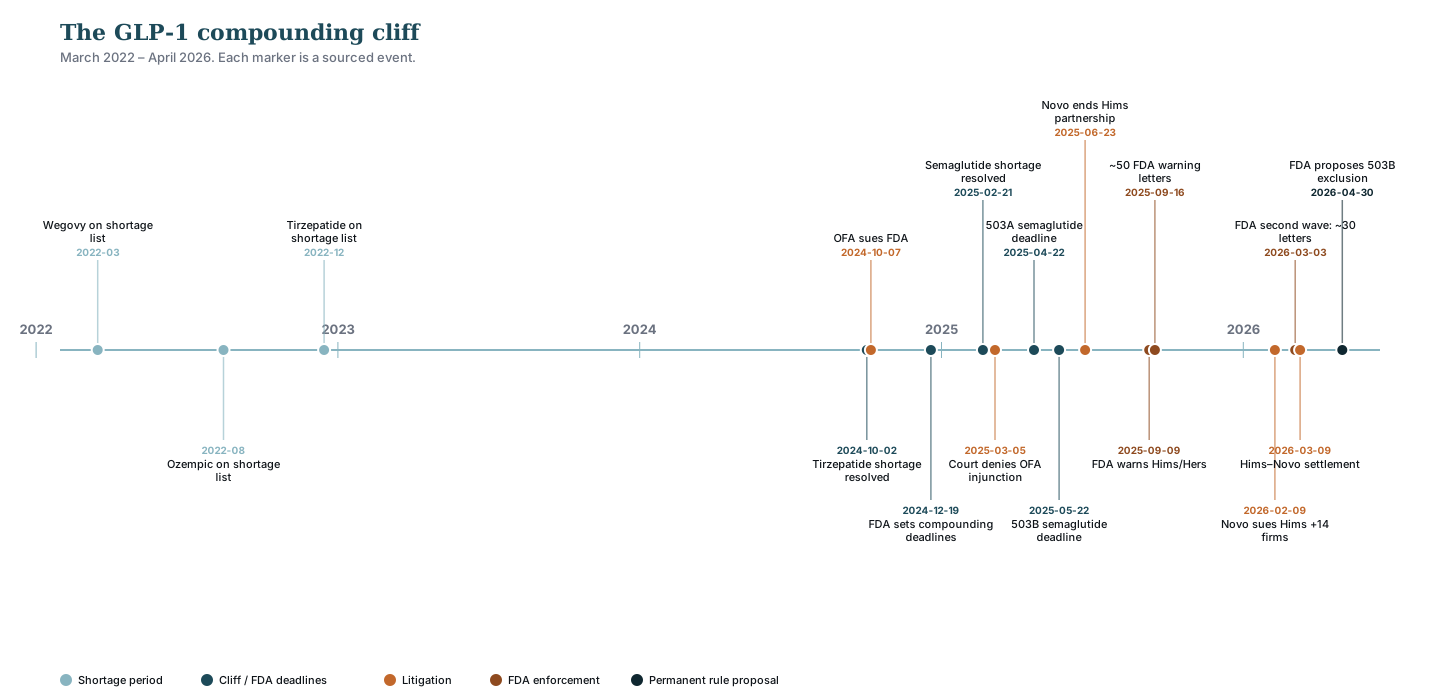
The story starts in 2022. By August 2022 the FDA had added both Wegovy and Ozempic (semaglutide) to its Drug Shortages list as demand for the new weight-loss class outran Novo Nordisk’s injector capacity. Tirzepatide followed in December 2022 (FDA tirzepatide order; Healio).
The legal effect was immediate. Under §503A(b), state-licensed compounding pharmacies may compound a copy of a commercially available approved drug only when that drug is on the shortage list. §503B(a)(2) extends similar authority to FDA-registered outsourcing facilities. With both GLP-1s on the list, hundreds of US compounders — 503A small pharmacies and 503B industrial-scale outsourcing facilities — began producing compounded semaglutide and tirzepatide and shipping them through telehealth platforms.
By mid-2024 the compounded GLP-1 channel had become a meaningful share of US prescriptions, representing approximately 30% of the total US supply at its peak (IQVIA). Hims & Hers added compounded injectable semaglutide to its weight-loss platform in May 2024 (SEC 10-Q, FY2024 Q3); Ro, Mochi, Henry Meds, Fella, Willow, and others rolled out their own offerings around the same time. Per-month pricing of $199–$299 was common.
October 2024 to March 2025: The tirzepatide cliff
The first reversal came fast. On October 2, 2024 FDA announced on its Drug Shortages page that the tirzepatide shortage was resolved — all doses, all presentations. The Outsourcing Facilities Association (OFA) and FarmaKeio Superior Custom Compounding filed suit in the Northern District of Texas five days later, arguing FDA had acted without notice or rational basis (BusinessWire; complaint via STAT News). Eli Lilly fired off hundreds of cease-and-desist letters to telehealth compounders the same week (STAT News).
On December 19, 2024 FDA issued a formal Declaratory Order reaffirming the resolution and giving compounders a brief grace period: 60 days for 503A pharmacies (until February 18, 2025) and 90 days for 503B facilities (until March 19, 2025) before enforcement began (Foley & Lardner). Judge Mark Pittman denied OFA’s preliminary-injunction motion on March 5, 2025, upholding FDA’s determination (Fierce Pharma). OFA filed an interlocutory appeal to the Fifth Circuit; that appeal’s outcome remains pending as of this writing.
February to May 2025: The semaglutide cliff
The semaglutide cliff was a near-replay. On February 21, 2025 FDA declared the semaglutide shortage resolved for all presentations (Healio; McDermott Will & Emery). The enforcement-discretion windows: 503A pharmacies until April 22, 2025; 503B facilities until May 22, 2025. OFA filed a second lawsuit three days later challenging the resolution; that suit is also pending.
By the end of May 2025 every FDA enforcement-discretion deadline had passed for both drugs. The path to legally compound semaglutide or tirzepatide at scale — copying the FDA-approved product because it was on the shortage list — was closed.
The enforcement cut patients off mid-treatment. In r/Semaglutide, one user who had lost 40 pounds wrote in May 2025: “my prescription was cancelled with the recent FDA changes. I’ll be focusing on continuing establishing good habits while decreasing my dose with the medication I have left.” Another, 93 pounds into their journey, noted they were “so thankful to have done this prior to the recent FDA actions” and had stocked nine to twelve months of medication in anticipation of the cut-off. The subreddit’s moderators simultaneously tightened their rules, pinning a reminder that “we do not permit the discussion of non-FDA approved formulations of semaglutide” — a phrase that appears now as the auto-moderator reply to almost every new post.
June 2025: Hims meets Novo
The most-watched event of the cliff was a partnership and its sudden end. In April 2025 Novo Nordisk and Hims & Hers announced a deal to sell brand-name Wegovy at $599/month through Hims’s platform via NovoCare Pharmacy — an explicit move to bring Hims’s GLP-1 customers onto the legal, brand-name product. On June 23, 2025, ten weeks later, Novo terminated the partnership, citing in a press release Hims’s “illegal mass compounding and deceptive marketing” of compounded semaglutide (Novo Nordisk PR; Pharmacy Times). Hims’s share price fell roughly 30% on the day; securities class actions followed within forty-eight hours.
The disagreement was over §503A(b)(1)(D). Hims kept selling compounded semaglutide after the cliff by relying on a statutory exception that lets a state-licensed pharmacist compound a drug for an identified patient when the prescriber documents that a change from the FDA-approved product produces “a significant difference” for that patient. Hims framed almost all of its compounded prescriptions as “personalised dosing.” Novo’s position was that Hims was using the language of personalisation to continue mass production.
September 2025 to March 2026: The enforcement wave
FDA agreed with Novo. On September 9, 2025 FDA issued separate warning letters to Hims and to its sister brand Hers, citing misleading marketing claims that compounded products contained “the same active ingredient as Ozempic and Wegovy” (FDA WL Hims 716567; FDA WL Hers 716825). A week later, on September 16, FDA published a batch of more than fifty additional warning letters to telehealth compounders and to both manufacturers for misleading GLP-1 marketing (Wilson Sonsini). The pattern continued in March 2026 with a second wave of roughly thirty warning letters to telehealth sites (Fierce Pharma).
For more on FDA's warning letter programme, see the GLP-1 warning letters explained article. The warning letters landed alongside a growing adverse-event record. By early 2025, FDA had received more than 455 adverse event reports linked to compounded semaglutide and more than 320 linked to compounded tirzepatide, many involving dosing errors from patients self-administering from multidose vials — some requiring hospitalisation. The safety record reinforced FDA’s enforcement posture.
In parallel, Eli Lilly began the litigation phase — suing Strive Pharmacy, Empower Pharmacy, and other compounders in April 2025 (Holland & Knight). Novo Nordisk followed with the biggest single action of the saga on February 9, 2026: a patent-infringement lawsuit against Hims & Hers in the District of Delaware, citing U.S. Patent No. 8,129,343 (a semaglutide formulation patent that expires in December 2031), with companion suits filed the same day against fourteen other firms including Mochi Health, Fella Health, and Prism Aesthetics (CNBC; BW Healthcare World).
Hims pushed back briefly and then capitulated. In February 2026 the company launched a compounded oral semaglutide pill at $49/month and pulled it within roughly four days under FDA pressure and the new patent suit (BioPharma Dive). On the February 23, 2026 earnings call, CEO Andrew Dudum told investors the company would continue selling compounded GLP-1s under the personalised-dose framing. For the full Hims wind-down timeline, see Hims compounded GLP-1 wind-down (STAT News). Three weeks later that position reversed: on March 9, 2026 Hims and Novo announced a settlement — Hims agreed to stop advertising compounded GLP-1 products and to offer FDA-approved Wegovy (injectable and oral) and Ozempic at Novo’s self-pay prices; Novo dismissed the patent suit, reserving the right to refile on breach (HMP Global; Hims newsroom — Wegovy now available). The other fourteen Novo-named defendants remain in active litigation.
April 2026: The permanent door
The most consequential piece of news, for anyone trying to read the medium-term, came on April 30, 2026. FDA proposed to exclude semaglutide, tirzepatide, and liraglutide from the permanent 503B Bulk Drug Substances list (FDA press release; Federal Register).
The 503B bulks list is the future trap-door. It governs whether outsourcing facilities can compound from bulk active pharmaceutical ingredient when no shortage is in effect — the legal route for permanent mass-market compounding outside a shortage. By proposing to keep all three GLP-1s off that list, FDA is signalling that even a future shortage would not restore industrial-scale compounding.
The FDA was explicit in its rationale: affordability is not clinical need. The agency drew a direct line between the statutory standard — “clinical need” as written in §503B — and cost, writing that “supply-related issues like backorders are not what the statute means by clinical need.” The fact that branded drugs are expensive, even prohibitively so for some patients, does not by itself create a statutory pathway for industrial compounding. That distinction will likely face a legal challenge; it is also the argument the manufacturers have been making since the cliff began. Public comment closes June 29, 2026.
The reaction in patient communities has been predictable. In r/Semaglutide, posts from the spring and summer of 2025 show a consistent thread of frustration: one commenter summarised the sentiment that has accumulated across hundreds of posts — “Only 1k a month for safety. If they gave a shit they’d drop the price” — and noted the irony of the FDA’s stated safety rationale while brand-name prices remained out of reach for uninsured patients. The concern is legitimate as a public-health observation; it is not, as of May 2026, a legal argument that has succeeded in any court.
What still works under §503A(b)(1)(D)
The narrowest remaining door is the personalised-need pathway. It permits a 503A state-licensed pharmacist to compound a drug for an identified patient when the prescriber documents in writing that the change makes “a significant difference” for that patient. Examples that arguably qualify: a true intolerance to an inactive ingredient in the brand product; a non-commercial dose between FDA-approved strengths during a deliberate clinical taper; a combination preparation (e.g. with B12, glycine, or an anti-nausea agent) where the combination is clinically justified. For definitions of the key compounding terms used in these debates, see our compounding glossary.
Examples that arguably do not qualify, per FDA’s recent warning letters: identical chemical entity at a standard FDA-approved dose, marketed at lower cost. The boundary is what the courts are now deciding.
Some providers have responded to the enforcement pressure by pivoting to weekly-titration protocols or unusual dose combinations — moves that are, in effect, attempts to document clinical individualisation for a patient population that is otherwise receiving a standard product. FDA has signalled in warning letters that it views these as pretextual.
What this means for patients
Three practical takeaways:
- If your provider is selling you compounded semaglutide or tirzepatide in May 2026, ask which legal pathway they are using. If the answer is “the shortage” or vague, that is now wrong. If the answer is §503A(b)(1)(D) with a documented clinical reason on your file, the legal posture is at least defensible — though not guaranteed against a future court ruling. If your program has already been cut off, our guide to what to do after a discontinued compounded GLP-1 lays out every path from here, and where to get compounded semaglutide in 2026 maps what narrowly remains.
- The price gap that drove the compounded boom has narrowed. Wegovy cash pay through NovoCare is $349/month (introductory $199/month for the two lowest doses); Zepbound vials through LillyDirect are $299–$449/month depending on dose. We cover both in detail on our cost pages: Wegovy cost and Zepbound cost.
- The most likely next change is a court ruling on the personalised-dose pathway. A loss for the compounder side — or a Fifth Circuit ruling on the OFA tirzepatide appeal — would tighten the door further. We refresh this page on every FDA filing, federal-court ruling, or major manufacturer enforcement action; the running update history sits at the foot of this article.
How we keep this article current
This timeline moves faster than most pages on the site because litigation and FDA enforcement are still in motion. We recheck it monthly and on any FDA filing, federal-court ruling, or major manufacturer enforcement action. These are the points most likely to drift between updates:
- The personalised-dose carve-out under §503A(b)(1)(D). This is the active legal fault line. A court decision against it, a final FDA guidance, or a Fifth Circuit ruling on the OFA appeal could each close or narrow the pathway with little notice.
- Compounded oral semaglutide. That product class did not really exist a year ago and now has at least one patent suit attached, so the status here can change quickly.
- The April 30, 2026 503B proposed rule. The public-comment period closes June 29, 2026; a final rule could change the legal landscape for outsourcing facilities by year-end.
If you are deciding between brand-name and compounded in mid-2026, treat the regulatory status as something to recheck monthly rather than something settled.
If you spot an error or a missing source on this page, please email [email protected]. We acknowledge corrections within five business days and publish the resolution within fifteen.
Frequently asked questions
Is it still legal to buy compounded semaglutide or tirzepatide in the US?
It depends on the configuration. Mass-market compounded copies of FDA-approved GLP-1s — at standard doses, marketed as cheaper Wegovy or Zepbound — are no longer permitted; all FDA enforcement-discretion windows ended by May 22, 2025. Some compounding under FDC Act §503A(b)(1)(D) is still arguably legal where a state-licensed pharmacist documents that a specific patient needs a specific change (non-standard dose, allergy to an inactive ingredient, combination product). FDA, Novo Nordisk, and Eli Lilly contend that most telehealth providers using 'personalized dose' framing are stretching that exception. Multiple lawsuits and warning letters are pending.
What were the FDA deadlines for compounders to stop producing GLP-1s?
Tirzepatide: 503A pharmacies had until February 18, 2025; 503B outsourcing facilities had until March 19, 2025. Semaglutide: 503A had until April 22, 2025; 503B had until May 22, 2025. All four dates have passed.
What is the difference between 503A and 503B compounders?
503A pharmacies compound for individual patients on receipt of a prescription, are state-licensed, and operate at small scale. 503B outsourcing facilities are FDA-registered, can compound without patient-specific prescriptions, and operate at industrial scale. Both lost their statutory authority to compound semaglutide and tirzepatide at scale when FDA declared the shortages resolved.
Why are some telehealth providers still selling compounded GLP-1s?
They rely on FDC Act §503A(b)(1)(D), which permits a state-licensed pharmacist to compound a drug for an identified individual patient when the prescriber determines a change from the FDA-approved product produces 'a significant difference' for that patient — for example a different dose, an added vitamin like B12, or sublingual rather than injectable. FDA and the manufacturers argue this is being used as a marketing label for what remains industrial-scale production. Whether the courts agree will determine the size of the compounded market in 2027.
What happened with Hims and Novo Nordisk?
In April 2025 Hims and Novo Nordisk announced a partnership to sell brand-name Wegovy at $599 per month through Hims's platform. On June 23, 2025 Novo terminated the partnership, citing what it called Hims's 'illegal mass compounding and deceptive marketing' of compounded semaglutide. Hims's stock fell roughly 30 percent on the day. Novo filed a patent-infringement lawsuit against Hims on February 9, 2026 along with parallel suits against fourteen other firms. The Hims piece settled three weeks later: on March 9, 2026 Hims agreed to stop advertising compounded GLP-1 products and now offers FDA-approved Wegovy (injectable and oral) and Ozempic at Novo's self-pay prices. The other fourteen defendants remain in active litigation.
How much do brand-name Wegovy and Zepbound cost now?
After list-price cuts that landed in late 2025 and early 2026, Wegovy cash pay is $349/month from Novo Nordisk's NovoCare Pharmacy with a $199/month introductory rate for the two lowest doses. Zepbound is sold in vials through LillyDirect at $299/month (starter), $399/month (5 mg), and $449/month (higher doses). The narrowed price gap is itself part of why the compounding cliff matters less to patients than it did a year ago.
What was the FDA's April 30, 2026 proposal about?
FDA proposed to keep semaglutide, tirzepatide, and liraglutide off the permanent 503B Bulk Drug Substances list. That list determines whether outsourcing facilities may compound from bulk active pharmaceutical ingredient when no shortage exists. Keeping all three GLP-1s off the list removes the only future pathway for mass-market compounding even if a shortage recurred. The FDA's stated rationale is that affordability gaps are not the same as clinical need, and clinical need is the statutory standard. Public comment runs through June 29, 2026.
Where is this article going to be wrong soonest?
The personalized-dose carve-out under §503A(b)(1)(D) is the most active legal question and the most likely change point. A court ruling, a Fifth Circuit decision on the Outsourcing Facilities Association appeal, or a final FDA guidance could close or narrow that pathway with little notice. We refresh this page on any FDA filing, federal court ruling, or major manufacturer enforcement action. Subscribe and we will email you when this page changes substantively.