How to Switch From Compounded to Brand-Name GLP-1 (2026 Guide)
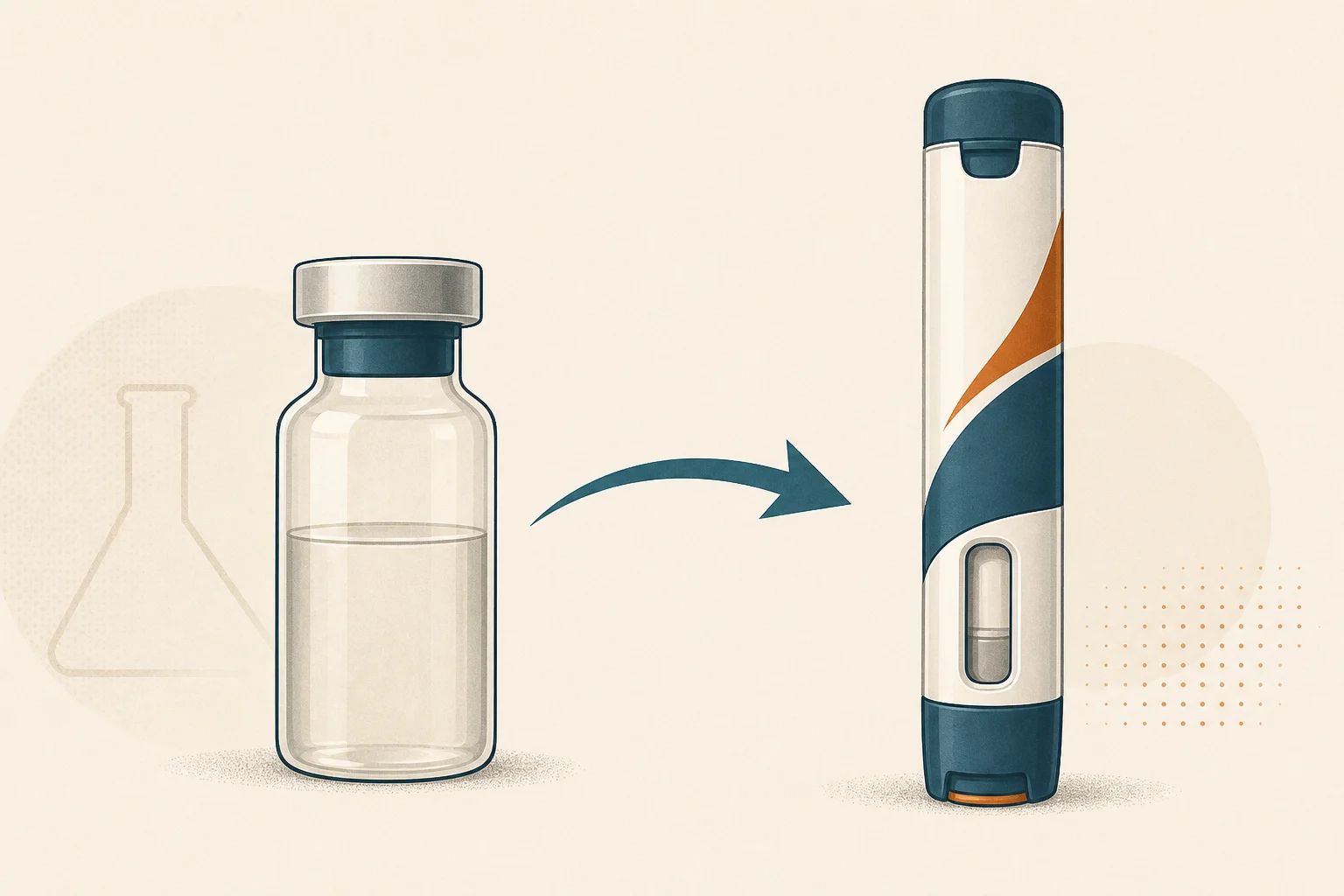
Your compounded supply is ending — or is already gone.
If you were using a Hims-prescribed compounded semaglutide program, the March 9, 2026 settlement between Hims and Novo Nordisk formally closed that chapter. If your telehealth provider shut down its compounding operation quietly, you may have learned via a brief email. And if you are still receiving compounded GLP-1 and wondering how long it will last, the FDA's enforcement actions through 2025 and early 2026 have made the answer increasingly clear: the window is closed for mass-market compounded GLP-1s, and the transition to branded is the only path forward for most patients.
This guide covers what you actually need to do now — step by step, with exact costs and realistic timelines as of May 2026.
Why This Switch Is Happening
The FDA declared the semaglutide injection shortage resolved on February 21, 2025. It had already declared the tirzepatide shortage resolved on October 2, 2024. Those two declarations are the legal engine behind everything that followed.
Under US compounding law, 503A and 503B pharmacies were permitted to produce copies of shortage-listed drugs. Once a drug leaves the shortage list, that exemption collapses. Enforcement-discretion deadlines for 503A compounders expired on April 22, 2025 for semaglutide (February 18, 2025 for tirzepatide). The final 503B deadline was May 22, 2025.
The Hims situation crystallised what the regulatory shift meant for patients at scale. Hims had built one of the largest compounded semaglutide programs in the US. Novo Nordisk sued for patent infringement in February 2026. On March 9, 2026 — roughly two weeks later — Hims settled. The terms: Hims stops advertising compounded GLP-1 products and transitions existing patients to FDA-approved Wegovy and Ozempic at Novo's self-pay prices. New Hims patients now default to branded products.
The broader picture: FDA has issued roughly 85 warning letters across two enforcement waves targeting compounders and telehealth firms. Eli Lilly has pursued parallel litigation against multiple compounders. By mid-2026 the legal, regulatory, and contractual scaffolding supporting mass-market compounded GLP-1 programs has been dismantled.
For a full timeline, see our FDA compounding cliff piece and the account of the Hims wind-down. If you are weighing all five options rather than only the brand switch, start with our step-by-step guide for when your compounded GLP-1 was discontinued. The practical result is immediate: hundreds of thousands of patients who built their treatment around a $150–$350 monthly compounded program are now navigating a branded market that starts at roughly twice that cost — or more, depending on the path.
What Patients Are Actually Worried About
Across patient forums and community discussions, three anxieties dominate when this topic comes up:
Cost shock. The pricing gap between compounded and branded is real and significant for uninsured patients. Patients who had structured their budgets around $150–$200/month compounded programs describe the shift as a financial disruption they were not warned about far enough in advance. Many had no idea the compounding window was closing until they got a provider notification email. "I was paying $200 a month — now I'm looking at $349 for the brand name just to get started" is the pattern. For patients without qualifying commercial insurance and ineligible for manufacturer savings programs (Medicare, Medicaid, VA beneficiaries), this gap has no easy resolution.
Dose uncertainty. Compounded pharmacies used varying concentrations, and patients frequently titrated to intermediate doses — 1.2 mg, 1.5 mg, 0.75 mg — not available on the branded schedule. The question of where exactly to land on a Wegovy or Zepbound dose scale after a custom regimen is genuinely unanswered by any official guidance. Patients who kept meticulous records of their compounded doses are in a meaningfully better position than those who cannot recall specifics. The concern is real: a conservative restart at 0.25 mg after months at 1.7 mg means weeks of titration before returning to a therapeutic dose.
Supply gap anxiety. The fear of a weeks-long coverage gap — and what happens to appetite control and weight momentum during it — is the most consistent emotional thread in these discussions. Patients who worked to establish progress on compounded understandably do not want to lose ground while insurance bureaucracy plays out. Prior authorization timelines are unpredictable, and patients who have never navigated commercial insurance PA for a GLP-1 often underestimate how long it takes.
Understanding these three fears is part of planning the switch properly.
Step 1: Document Your Compounded Dosing History Now
Before you contact your prescriber, gather your records. This step takes 30 minutes and directly determines how smoothly everything else goes.
What to document:
- Exact current dose — what mg you inject weekly, not just the vial concentration
- Date of your last injection
- Full titration history — every dose you used before reaching your current dose, and for how long you held each
- Side effect history — what caused problems, what prompted dose adjustments, what was tolerable
- Provider contact information for any clinical notes they hold
If your compounded provider has your records, request them formally under HIPAA. They are legally required to provide them within 30 days, and many do it faster when asked directly. This is worth doing even if you feel you remember your history clearly — your new prescriber will want documentation, not your recollection.
Why this matters concretely: branded prescribers use your documented history to decide where on the dose scale to place you. A clear record showing twelve weeks at 1.0 mg semaglutide without significant side effects translates differently than "I think I was on the medium dose." Patients with vague histories are more likely to be restarted conservatively at 0.25 mg Wegovy, adding months of titration before returning to a therapeutic level.
Step 2: Get a New Prescription
This is the step that surprises most patients: your compounded prescription does not transfer to a branded pharmacy. A compounded script is written for the compounding pharmacy filling it, for a specific non-FDA-approved formulation. To receive Wegovy, Zepbound, Ozempic, or Mounjaro through any branded channel — NovoCare, LillyDirect, a retail pharmacy, or a telehealth platform — your prescriber must write a fresh Rx for the FDA-approved product.
You have three routes:
Your primary care physician or specialist. If you have an established prescriber who manages your GLP-1 treatment, this is the lowest-cost path. Most can issue the new Rx during a standard visit or telehealth check-in. If they want to restart you conservatively — say, at 0.25 mg Wegovy even if you were at 1.7 mg compounded — that is a clinical decision worth discussing calmly, with your documentation in hand.
Your existing telehealth provider switching to branded. If you were using Hims, Ro, or another platform that has moved to branded, they may already be arranging your transition. Check your account portal and any emails from them. Platforms like Ro that have built integrated branded delivery can issue a new Rx and connect you to NovoCare directly within the same workflow.
A new telehealth provider. If your current provider has stopped operating or cannot issue branded Rx, you can start fresh with a telehealth service that handles branded GLP-1 prescribing. Standard intake typically takes one to three days.
Step 3: Choose Your Access Path
With a new Rx in hand, you have four main routes to branded Wegovy or Zepbound.
NovoCare Direct (Wegovy) — $199 intro, then $349/month
Novo Nordisk's own direct pharmacy program. Patients new to NovoCare or the Wegovy Savings Offer pay $199/month for each of the first two fills at 0.25 mg or 0.5 mg (introductory rate through June 30, 2026), then $349/month for any dose from 0.25 mg through 2.4 mg. The higher-intensity Wegovy HD 7.2 mg runs $399/month.
Eligibility: valid Wegovy prescription, on-label indication (BMI ≥30, or ≥27 with a weight-related comorbidity), not enrolled in any federal or state prescription drug benefit program. This means no Medicare, Medicaid, VA, TRICARE, or equivalent.
The oral Wegovy tablet (1.5 mg and 4 mg, FDA-approved December 2025) runs $149/month for the two introductory doses, stepping up to $299/month for higher doses through NovoCare.
For the full enrollment walkthrough, see NovoCare Wegovy enrollment.
LillyDirect (Zepbound) — $299–$449/month
Eli Lilly's self-pay vial and KwikPen program, pricing under the Self Pay Journey Program: $299/month for 2.5 mg, $399/month for 5 mg, $449/month for 7.5 mg through 15 mg. These are program prices; list pricing without the program at higher doses is substantially higher ($499–$699).
Eligibility: valid Zepbound Rx, on-label indication, not enrolled in a federal or state prescription drug benefit program. To maintain program pricing, you must complete each refill within 45 days of your previous delivery — do not let it lapse.
For the full enrollment walkthrough, see LillyDirect Zepbound enrollment.
Commercial Insurance with Prior Authorization — $0–$25/month (if covered)
If your commercial insurance covers GLP-1s for weight management — roughly 40–45 percent of large employer plans do — this is ultimately the cheapest path. With the manufacturer copay card, commercially insured patients can pay as little as $0–$25/month.
The friction: prior authorization. Most plans require PA before covering a branded GLP-1 for weight loss. That process typically takes 3–14 days with an expedited request, but can run longer. File PA documentation early — as soon as your new Rx is written. If denied, have a self-pay backup plan ready.
Note: prior compounded use does not disqualify you from insurance coverage, and it does not satisfy a branded GLP-1 PA requirement. It is a separate process from scratch.
Telehealth-Mediated Branded — NovoCare prices + platform fee
Platforms like Ro bundle prescribing, insurance navigation, and pharmacy delivery into a single subscription. Branded Wegovy through Ro at steady state runs roughly $349/month for the injectable plus a platform fee of approximately $149/month. The trade-off: you pay for a support layer. This is a reasonable choice if you want assistance navigating insurance for the first time, but it is not the cheapest option for patients who can go direct.
Step 4: Understand Dose Alignment
The good news: branded dose scales and typical compounded dose ranges are built around the same active molecules at similar amounts.
Wegovy (semaglutide) dose scale: 0.25 mg → 0.5 mg → 1 mg → 1.7 mg → 2.4 mg → 7.2 mg (HD). Standard titration is four weeks at each step, stepping up as tolerated. See our Wegovy dose escalation guide for what to expect at each step.
Zepbound (tirzepatide) dose scale: 2.5 mg → 5 mg → 7.5 mg → 10 mg → 12.5 mg → 15 mg. Starting dose is 2.5 mg for four weeks, then titrated up.
The practical challenge. Compounded pharmacies used varying concentrations, and patients frequently titrated to intermediate doses — 0.75 mg, 1.2 mg, 1.5 mg — not available in the branded schedule. A patient at compounded 1.2 mg weekly semaglutide falls between the 1.0 mg and 1.7 mg Wegovy steps. Where your prescriber places you depends on your documented tolerance history, any treatment gap, and their clinical judgment — there is no official conversion chart. If your compounded dose was written in units rather than milligrams, our compounded-to-brand dose conversion guide shows how to calculate the weekly milligram figure to bring.
What the Wegovy prescribing information says: if there has been a significant treatment gap, titration may need to be reinitiated to reduce GI side effects. This is not always applied as a hard rule — many patients with well-documented histories and good tolerance restart close to their previous dose with minimal side effect increase. Bring your dosing records. The prescriber cannot make a well-informed decision without them.
One additional difference: many compounded formulations included additives — B12, B6, glycine, pyridoxine — that branded Wegovy and Zepbound do not contain. If those additives were clinically meaningful for you, discuss the gap with your prescriber before switching.
Step 5: Time the Transition
Target a 7-day gap between your last compounded injection and your first branded dose — the same weekly interval you already use. Semaglutide has a half-life of roughly seven days; tirzepatide is similar. A normal weekly gap means you carry meaningful drug levels into your first branded injection.
Do not allow a gap beyond two weeks if avoidable. Beyond two weeks, drug levels decline materially. Appetite suppression weakens. You may see some weight gain — mostly from increased food intake and water retention, not fat tissue accumulation. More importantly, a gap beyond two weeks is a clinical signal that your prescriber may use to recommend restarting at a lower dose tier.
Realistic timeline from decision to first branded dose
| Action | Estimated timing |
|---|---|
| Gather dosing records, request HIPAA records if needed | Day 0–2 |
| Prescriber visit or telehealth consultation | Day 1–4 |
| New Rx issued | Day 3–5 |
| Enroll in NovoCare or LillyDirect (self-pay) | Day 4–6 |
| First shipment arrives (NovoCare or LillyDirect direct) | Day 10–14 |
| Submit insurance PA | Day 4–5 |
| PA decision received | Day 10–20 |
| First fill under insurance coverage | Day 12–22 |
The practical rule: start this process at least two weeks before your last compounded dose is scheduled. If you are already down to your final vial, begin today and treat NovoCare or LillyDirect self-pay as a bridge while insurance PA processes — if insurance is your target path.
What the Switch Costs
For patients coming off a typical $150–$300/month compounded program, the monthly cost increase at uninsured self-pay rates is real and significant.
| Path | Semaglutide monthly cost | Tirzepatide monthly cost |
|---|---|---|
| Compounded (typical 2026 cash pricing) | $150–$300 | $200–$350 |
| NovoCare direct (Wegovy injectable) | $199 intro, then $349 | N/A |
| NovoCare direct (Wegovy oral) | $149 intro, then $299 | N/A |
| LillyDirect (Zepbound) | N/A | $299–$449 by dose |
| Telehealth-mediated branded | $349 + ~$149 platform fee | $299–$449 + platform fee |
| Commercial insurance + copay card | $0–$25 (if covered) | $0–$25 (if covered) |
The most significant cost improvement for most patients comes from qualifying commercial insurance coverage. For those without qualifying commercial coverage — including all Medicare, Medicaid, VA, and TRICARE beneficiaries — the direct programs are the designed pathway, and the cost increase is real.
The July 1, 2026 Medicare GLP-1 Bridge program will provide branded Wegovy and Zepbound coverage for Medicare beneficiaries at a flat $50/month copay — but only for FDA-approved branded products. Compounded GLP-1s are not covered under that program.
For a broader comparison of where to find the lowest cost, see our cheapest place to get Wegovy analysis.
Risks to Plan Around
The supply gap. The most controllable risk in this entire process. Do not wait until your last compounded dose to start. The 10–14 day estimate for self-pay branded delivery is achievable if you begin early. PA routes take longer and should never be used as a sole strategy without a self-pay backup.
Prior authorization denial. PA denials happen, and the most common reasons are predictable: BMI below the threshold without a documented comorbidity, formulary exclusion for weight loss, or incomplete documentation from your prescriber. Have a self-pay fallback in place before you submit. A denial should not also mean you run out of medication.
Dose restart. If your prescriber places you at a lower dose than your compounded history suggests, this is a conservative interpretation of the prescribing guidance — not a failure. It adds 4–12 weeks of titration time. Bring documentation and discuss it, but accept that the clinical decision is theirs to make.
Cost sticker shock. If your commercial plan does not cover GLP-1s and you do not qualify for manufacturer programs, self-pay at $349–$449/month is a real cost increase over typical compounded pricing. Budget for this before you receive the first invoice, not after.
What Changes When You Switch to Branded
Beyond price and regulatory status, there are meaningful practical differences.
Manufacturing standards. Branded Wegovy and Zepbound are manufactured under FDA-monitored Good Manufacturing Practice controls with rigorous batch testing for potency, purity, and sterility. Compounded semaglutide varied by pharmacy — the FDA documented instances of potency variability and sterility concerns during the peak compounding period.
Dose precision. Branded autoinjector pens deliver fixed labeled doses with no patient measurement. Compounded vials required patients to draw their own doses with syringes, introducing variability in actual delivered dose. The pen format removes that variable entirely.
Inactive ingredients. Branded Wegovy and Zepbound contain specific excipients studied in the clinical trials. Some compounded formulations added vitamins or other compounds. The branded versions will not include those additives — worth noting if any additive was clinically intentional rather than documentation scaffolding.
Autoinjector format. Both Wegovy and Zepbound come as pre-filled autoinjector pens. The Wegovy oral tablet eliminates injection entirely and may be preferable for some patients, though it carries a different dosing window requirement (empty stomach, 30-minute post-dose food delay).
Frequently Asked Questions
Can I transfer my compounded semaglutide prescription to a branded pharmacy? No. A compounded prescription is written for the specific compounding pharmacy that fills it. A branded pharmacy requires a new prescription written for the FDA-approved product.
What dose of Wegovy do I start on after compounded semaglutide? There is no official conversion chart. Bring your documented dosing history. Your prescriber will decide based on your dose, tolerance, and any treatment gap. Gaps beyond two weeks typically trigger conservative restarts at a lower tier.
What dose of Zepbound do I start on after compounded tirzepatide? The Zepbound scale (2.5, 5, 7.5, 10, 12.5, 15 mg) aligns closely with standard compounded tirzepatide dosing. Your prescriber should confirm your starting dose based on your history and any gap in treatment.
How long should I wait between my last compounded dose and my first branded dose? Approximately seven days — the same weekly interval you already use. Flag any gap beyond two weeks to your prescriber.
Does prior compounded use disqualify me from manufacturer savings programs? No. Both NovoCare and LillyDirect disqualify patients currently enrolled in federal or state drug benefit programs — not patients with a prior compounded history.
How long until I get my first branded shipment? Self-pay direct (NovoCare or LillyDirect): 10–14 days from prescriber visit. Insurance with prior authorization: add 2–4 more weeks.
Will I gain weight during the switch? A brief, well-timed switch should not cause meaningful fat gain. Scale movement in the first week or two typically reflects water retention, not fat. Longer gaps — two weeks or more — can affect appetite control; discuss timing with your prescriber.
Does insurance that covered compounded GLP-1 automatically cover branded? No. Branded coverage requires its own PA and depends on your plan's specific formulary. Many commercial plans that excluded compounded versions do cover branded — but you need to verify and file separately.
This article is editorial and informational only. It is not medical advice and does not constitute a recommendation for any specific treatment, dose, or prescriber. Discuss all medication decisions — including how and when to switch formulations and what starting dose is appropriate — with a licensed healthcare professional.