Mochi Health Review: GLP-1 Telehealth with Insurance Support (2026)
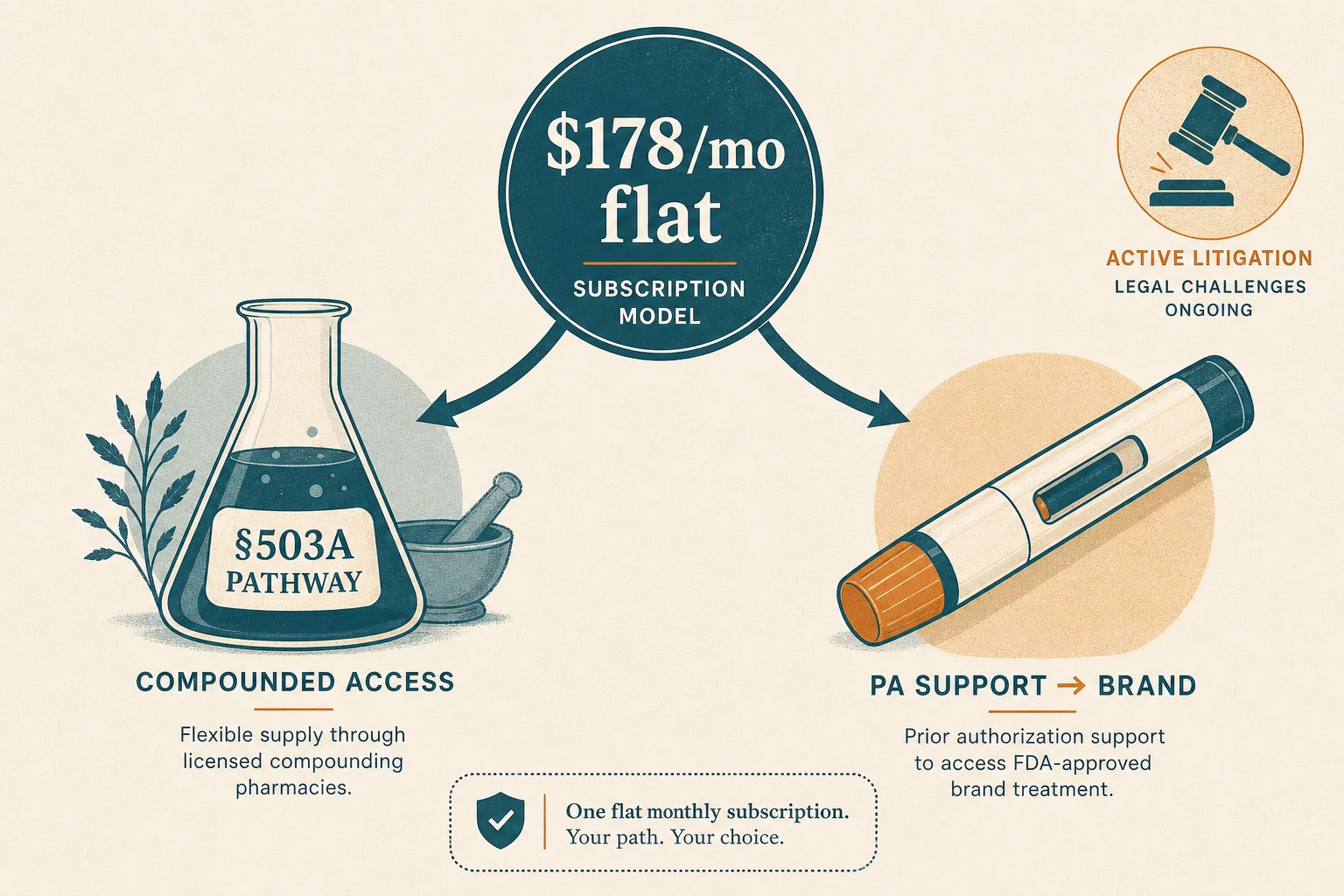
Most GLP-1 telehealth providers in 2026 have chosen one of two lanes: the cash-pay compounding lane, or the insurance-facilitated branded-prescription lane. Mochi Health operates in both. They accept some commercial insurance and provide prior-authorisation support for patients whose plans cover Wegovy or Zepbound. For patients whose insurance does not cover GLP-1s, they offer compounded semaglutide and tirzepatide under the §503A(b)(1)(D) framing.
This dual-path model is Mochi’s main differentiation. But in 2026, any review of Mochi has to address two developments that did not exist when earlier versions of this review were written: the March 2025 shutdown of Mochi’s primary pharmacy partner Aequita, and an active Eli Lilly patent-infringement lawsuit that survived Mochi’s motion to dismiss in April 2026.
This review covers how each path actually works, what it costs, what the sign-up and support experience looks like, and what both risks mean in practice.
Mochi at a glance
| Founded | 2021, San Francisco CA |
| Compounding status (May 2026) | Operational — §503A(b)(1)(D) framing |
| FDA warning letter received | No (as of May 2026) |
| Eli Lilly lawsuit status | Active — motion to dismiss denied April 2026 |
| Aequita pharmacy status | Shut down March 2025; Mochi using alternate pharmacies |
| Insurance-path available | Yes — commercial insurance with PA support |
| Membership fee | $79/month (multi-month plans available) |
| Cash-pay compounded semaglutide | $99/month medication + $79 membership = from $139/month |
| Cash-pay compounded tirzepatide | $199/month medication + $79 membership = from $169/month |
| Medicare / Medicaid / VA accepted | No |
| Ships to | Most US states |
This article is an editorial-only review — clinical-care scoring is deferred to the phase following MD reviewer onboarding.
The two 2026 risks: Aequita and Eli Lilly
Before the program details, these two developments deserve direct treatment.
The Aequita pharmacy shutdown (March 2025)
Washington State’s Pharmacy Quality Assurance Commission halted production at Aequita Pharmacy in March 2025. The cited reason: Aequita allowed untrained and unqualified staff to perform sterile compounding and failed to properly supervise them. Aequita is a compounding pharmacy that was affiliated with Mochi Health and was responsible for fulfilling a significant portion of Mochi’s compounded tirzepatide orders.
The shutdown caused widespread patient disruption. Patients reported delayed or missing shipments with minimal advance notice from Mochi. Mochi has since transitioned to alternate compounding pharmacy partners. The current arrangement appears to have stabilised operations, but the Aequita episode is a concrete illustration of the supply-chain fragility inherent in relying on a single affiliated compounding pharmacy — and a reason to ask Mochi specifically which pharmacy your order will ship from before enrolling.
The Eli Lilly patent-infringement lawsuit
Eli Lilly filed suit against Mochi Health Corp. in the Northern District of California (Case No. 3:25-cv-03534-JSC) asserting three primary claims:
- False advertising (Lanham Act): Mochi allegedly misrepresented compounded tirzepatide as equivalent to FDA-approved Zepbound after the shortage designation ended.
- Corporate practice of medicine violations: Lilly alleges Mochi allowed non-clinical staff to influence medical decisions, including changing patient doses en masse without individual clinical consultation — the complaint describes at least five such mass dose changes in eight months.
- Distribution of unapproved drugs: Continued mass-scale production and sale after FDA guidelines no longer permitted such practices under the shortage-era rules.
In April 2026, U.S. District Judge Jacqueline Scott Corley partially denied Mochi’s motion to dismiss, allowing the lawsuit to proceed on the California Unfair Competition Law and federal Lanham Act claims. The case has not been resolved. The outcome could affect Mochi’s compounded tirzepatide program specifically — the claims focus on tirzepatide, not semaglutide, though the broader corporate-practice and FDA-compliance allegations touch the entire compounding operation.
Mochi continues to operate while the lawsuit proceeds. This is not an immediate shutdown risk, but it is material information for any patient considering a multi-month or annual subscription commitment.
Mochi in 2026 — current operating model
Insurance-friendly path
Mochi accepts some commercial insurance plans for the GLP-1 prescription component and provides active PA (prior authorisation) support to help patients navigate their insurer’s requirements. The PA process for GLP-1s typically involves documentation of BMI and comorbidities, evidence of a structured lifestyle program, and sometimes a step therapy requirement. Mochi’s clinical team handles the PA submission and follow-up as part of the membership.
If your commercial insurance covers Wegovy or Zepbound and you get PA approval, your drug cost drops from cash-pay levels to your plan’s copay or coinsurance for a specialty drug — which for some plans is near-zero with the manufacturer savings card. The Mochi membership fee continues regardless of whether insurance covers the drug. For patients with covering plans, the total cost (membership + $0–$50/month drug copay) is often far lower than any cash-pay compounding path.
Mochi’s membership now includes a “Wellness Plus” tier for patients with qualifying insurance, which bundles additional nutrition and mental health support benefits with up to 26% savings on the membership fee.
For patients whose insurance denies coverage, Mochi can support an appeal. If the appeal fails, the cash-pay path is available.
Cash-pay compounding path
For patients who cannot use or do not have insurance covering GLP-1s, Mochi offers compounded semaglutide and tirzepatide under the §503A(b)(1)(D) significant-difference framing. Mochi’s pricing is flat-rate regardless of dose — the compounded semaglutide price of $99/month stays the same whether you are at a starter 0.2 mg dose or a maintenance 2 mg dose. This is a meaningful structural advantage over providers that apply dose-tier surcharges.
True monthly costs:
- Compounded semaglutide: $99/month (medication) + $79/month membership = from $139/month
- Compounded tirzepatide: $199/month (medication) + $79/month membership = from $169/month
Multi-month membership plans (quarterly, semi-annual, annual) reduce the effective per-month membership cost below $79.
Compounding-status reality (May 2026)
Mochi has not received an FDA warning letter as of May 2026. We verify this monthly against the FDA warning-letter database. The legal framework Mochi relies on for its compounding program is the same contested one that Henry Meds, Calibrate, and other remaining providers use. The Eli Lilly lawsuit adds a layer of provider-specific legal pressure beyond the sector-wide enforcement environment. For the broader regulatory context, see the compounding cliff timeline and the Mochi compounded status tracker.
The sign-up and intake experience
Intake form depth
Mochi uses an online intake questionnaire that covers health history, BMI, comorbidities, medications, and contraindications consistent with the Wegovy and Zepbound prescribing-label requirements. The intake also includes an insurance-verification step: you provide your insurance information, and Mochi checks whether your plan covers GLP-1 weight-loss medications before you commit to the membership fee.
Sign-up to prescription timeline
Insurance verification adds a step: it typically takes 1–3 business days to complete. If insurance is confirmed covering, the PA process begins — PA timelines vary by insurer and plan, typically 1–4 weeks. Mochi states it will provide interim medications while awaiting PA approval. If insurance is confirmed not covering, you can elect the cash-pay compounded path, and prescription issuance typically follows within 1–3 business days.
For cash-pay patients without an insurance step, the intake-to-prescription timeline is comparable to other asynchronous providers.
Formulary
Insurance path — branded GLP-1s: Mochi prescribes FDA-approved branded medications (Wegovy, Ozempic, Zepbound, Mounjaro) when insurance covers them. These are dispensed through the patient’s in-network pharmacy, not shipped directly from Mochi.
Cash-pay path — compounded options:
- Compounded semaglutide: flat $99/month regardless of dose — starter to maintenance
- Compounded tirzepatide: flat $199/month regardless of dose — starter to maintenance
- Formulations include standard injectable and in some cases sublingual — verify current formulary directly with Mochi
Pricing reality
Total-cost model for insurance patients
For patients with commercial insurance that covers GLP-1s:
- Mochi membership: ~$79/month (standard) or lower on multi-month plans
- Drug copay after PA approval: $0–$50/month with manufacturer savings card in most cases
- Total: ~$79–$129/month
This compares favourably to any cash-pay path when insurance covers the drug.
Total-cost model for cash-pay patients
| Path | Monthly medication | Membership fee | Total |
|---|---|---|---|
| Mochi compounded semaglutide | from $99/month | $79/month | from $139 |
| Mochi compounded tirzepatide | from $199/month | $79/month | from $169 |
| Mochi compounded semaglutide pill | from $62 | $79/month | from $141 |
| Mochi branded Wegovy | from $199 | $79/month | from $278 |
| Mochi branded Zepbound | from $299 | $79/month | from $378 |
| Henry Meds compounded sema (standard dose) | $297 | Included | $297 |
| NovoCare branded Wegovy | $349 | None | $349 |
| Hims branded Wegovy oral (steady state) | $149 | $149 | $298 |
Mochi cut its compounded medication prices sharply during 2026: semaglutide moved from $99 to a from-price of $60, and tirzepatide from $199 to $90. At the advertised floor that puts a cash-pay semaglutide patient at roughly $139 a month all-in, which is among the cheapest routes published by any major platform.
Read “as low as” literally. Every medication figure Mochi publishes is a floor, not a fixed rate. Its own pages state that medication is not included in the membership and that “medication availability and pricing vary by state.” The old flat-rate-regardless-of-dose model no longer applies, so the number you are quoted at your dose, in your state, may be higher than the headline. Verify before you switch on price.
Mochi has also widened its formulary well beyond the two compounded injectables: a compounded semaglutide pill from $62, compounded orforglipron from $31, metformin from $13, and branded Wegovy, Ozempic, Zepbound and Mounjaro through the same membership.
Insurance navigation — which plan types Mochi works with
Mochi accepts most major commercial insurance plans for the insurance-navigation path. Government payers (Medicare, Medicaid, VA, TRICARE) are excluded. Plans that commonly cover GLP-1s for weight management include large employer self-insured plans and some ACA marketplace plans. The only reliable way to verify whether your specific plan and benefit tier covers GLP-1s is to go through Mochi’s insurance-verification step or call your insurer directly.
What patients say: Reddit signal on Mochi
Reddit discussions across r/Semaglutide, r/Ozempic, and r/WeightLoss reflect several consistent themes about Mochi as of 2025–2026:
On the pricing structure: Users who understand the medication-plus-membership split explicitly value the dose-independence Mochi offered under its older flat-rate model. One comment noted that because the price does not increase at higher doses, patients avoid the ~$1,200/year premium they would pay with dose-tiered providers at maintenance. The flip side is that some users express frustration at not realising the $79 membership fee exists until they see the billing — the medication headline gets more airtime than the true all-in total.
On the insurance PA support: Patients who successfully navigated PA through Mochi frequently credit the support team with doing the heavy lifting on documentation submission and insurer follow-up. This is the most commonly cited reason patients choose Mochi over simpler asynchronous providers. The experience is not universal — PA denials still occur, and appeal timelines vary by insurer.
On post-Aequita pharmacy disruptions: Patient accounts from 2025 include multiple threads describing medication delays and in some cases receiving compounded product with unexpected formulation changes following Aequita’s shutdown. Mochi apparently changed patient doses without individual consultation during this period — consistent with the allegations in Lilly’s suit. As of early 2026, pharmacy operations appear to have stabilised with alternate partners, but the episode is cited as a reason some patients switched providers.
On support responsiveness: Response times for routine questions are reported as 24–48 hours. Mochi’s dedicated weight-management clinical team model draws more positive comparisons to generic telehealth providers than to specialist compounders.
Support quality
Mochi operates a dedicated weight-management clinical team — a distinction from general primary care providers like Plushcare. Prescribers review your check-in data and message responses on a scheduled basis (typically monthly), plus on-demand messaging for questions. Response times for routine questions are typically 24–48 hours based on patient reports.
Cancellation experience
Cancel through your Mochi account portal or via support before the next billing cycle. The membership fee and medication billing are monthly; cancellation stops the next billing cycle but typically does not generate a refund for the current period. Your prescription records and clinical notes are available to you under HIPAA rights and can be transferred to another provider.
Best for / Not for
Mochi is best for:
- Cash-pay patients who anticipate reaching higher maintenance doses and want pricing that doesn’t scale with dose
- Cash-pay patients who may gain insurance coverage and want a provider that can navigate PA when that moment comes
- Patients whose current insurance has GLP-1 coverage but who face a complex PA process
- Patients who want a structured weight-management program with a clinical team rather than a minimal asynchronous prescriber
For a broader ranking of cash-pay telehealth platforms, see our best cash-pay GLP-1 telehealth guide.
Mochi is not ideal for:
- Patients who want certainty of uninterrupted supply and are concerned about pharmacy-partner stability (the Aequita episode is recent history)
- Patients starting tirzepatide who want to avoid provider-specific legal risk from the active Eli Lilly suit
- Patients on Medicare or Medicaid (excluded from Mochi’s program)
- Patients who want certainty of uninterrupted branded-drug access and whose insurance does not cover GLP-1s (NovoCare or LillyDirect direct would be more appropriate)
Mochi vs Plushcare
For the full side-by-side, see our Mochi vs Plushcare comparison. Plushcare is a general primary-care telehealth platform that prescribes FDA-approved GLP-1s for patients with covering insurance. Plushcare does not offer a dedicated weight-management program, active PA support, or compounded medications.
Mochi is the better fit if you want active PA navigation, a dedicated weight-management clinical team, or a compounding-aware provider. Plushcare is the better fit if your insurance already covers branded GLP-1s without a complex PA, you want a simple prescription, and you are already connected to a primary care provider for the ongoing relationship.
Mochi vs Henry Meds
For the detailed side-by-side, see our Henry vs Mochi comparison. Both offer compounded GLP-1 programs as of May 2026. The key differences:
- Insurance path: Mochi offers it; Henry Meds does not.
- Price for cash-pay compounding: Mochi is cheaper all-in at its advertised floor (from $139 vs $297 at Henry), though Mochi's figures are from-prices that vary by state while Henry's are fixed.
- Flat-rate vs dose-tiered pricing: Mochi’s flat-rate model is more predictable for long-term patients.
- Legal exposure: Henry Meds has no active manufacturer lawsuit as of May 2026; Mochi has an active Eli Lilly suit.
- Pharmacy history: Mochi’s Aequita disruption is recent; Henry has not had a comparable publicly reported pharmacy shutdown.
If you have commercial insurance with potential GLP-1 coverage, Mochi’s PA-support capability is worth the trade-offs. If you are purely cash-pay and focused solely on lowest cost with no insurance upside, Henry Meds is worth comparing — but the Mochi flat-rate may undercut Henry for patients who expect to need maintenance doses above 1 mg of semaglutide.
How we keep this article current
We update this review as the case, the supply chain, and the pricing move. Three things drift fastest, in order of immediacy:
- The Eli Lilly lawsuit. A ruling adverse to Mochi could affect the company’s compounded tirzepatide program specifically, and potentially broader operations. We update this review when there are material developments in the case.
- Compounding status and pharmacy-partner arrangements. The Aequita shutdown demonstrated that pharmacy-partner changes can disrupt supply with limited patient notice. If Mochi announces a new pharmacy partnership, changes its compounding formulary, or receives an FDA warning letter, we update the status box at the top of this article and note the change date.
- Pricing. Mochi’s flat-rate $99/$199 structure is a competitive differentiator worth checking directly before enrolling, as the competitive landscape can shift quickly.
For current compounding-status across all providers, see the compounding tracker. For NovoCare and LillyDirect enrollment if you are considering the branded cash-pay path, see NovoCare enrollment and LillyDirect enrollment.
If you spot an error or a missing source, email [email protected]. Our editorial policy and methodology explain how we source these reviews and what we disclose about conflicts of interest.
Frequently asked questions
Is Mochi Health legit in 2026?
Yes. Mochi Health is a licensed US telehealth company with a named medical director and a network of state-licensed prescribers. It operates a real insurance-navigation service for commercial insurance plans and a compounded-medication program for cash-pay patients. It is not a scam. The relevant 2026 questions are: (1) whether the Eli Lilly lawsuit currently proceeding in federal court will affect operations, and (2) whether the transition away from the Aequita pharmacy has fully resolved the supply-chain disruption that affected many patients in 2025.
Does Mochi Health accept my insurance?
Mochi works with some commercial insurance plans for the GLP-1 prescription and provides prior-authorisation support. Coverage varies substantially by plan. Medicare, Medicaid, and government-payer plans are not covered through the Mochi platform for the GLP-1 program. The best way to verify whether your specific plan is accepted is to start the Mochi intake, which includes an insurance-verification step.
How much does Mochi Health really cost?
The advertised minimum is from $139 for compounded semaglutide (from $60 medication + $79 membership) or from $169 for compounded tirzepatide (from $90 medication + $79 membership). Mochi publishes these as "as low as" prices and states that medication availability and pricing vary by state, so the figure quoted at your dose in your state may be higher. Multi-month membership plans reduce the effective per-month membership cost.
What happened with Mochi's Aequita pharmacy?
Washington State's Pharmacy Quality Assurance Commission halted production at Aequita Pharmacy in March 2025, citing untrained and unqualified staff performing sterile compounding without proper supervision. Aequita is a compounding pharmacy affiliated with Mochi. The shutdown caused widespread patient disruption and medication delays. Mochi transitioned to alternate pharmacy partners, but the disruption affected a meaningful number of patients during the transition period.
What is the Eli Lilly lawsuit against Mochi?
Eli Lilly filed suit in the Northern District of California (Case No. 3:25-cv-03534) alleging Mochi engaged in false advertising, corporate practice of medicine violations, and distribution of unapproved compounded tirzepatide after FDA guidelines no longer permitted such practices. In April 2026, U.S. District Judge Jacqueline Scott Corley denied Mochi's motion to dismiss the key claims, allowing the lawsuit to proceed. The outcome remains uncertain; the case has not been resolved.
Is Mochi still compounding semaglutide?
Yes, as of May 2026. Mochi operates compounded semaglutide and tirzepatide programs under a §503A(b)(1)(D) significant-difference framing, the same legal basis other remaining compounders use. Mochi has not received a public FDA warning letter as of this writing. The legal continuity of this program is subject to the same enforcement and litigation dynamics as all other compounding-dependent providers — plus the active Eli Lilly suit specifically targeting Mochi.
How long does Mochi take to ship?
After prescription verification, Mochi ships through partner compounding pharmacies. Based on published patient accounts, delivery typically takes 3–7 business days from prescription processing for most states. Following the Aequita pharmacy shutdown in March 2025 and the transition to new pharmacy partners, some patients reported extended delays. The current pharmacy arrangement appears stabilised, but supply-chain disruptions remain a risk for compounding-dependent providers generally.
How is Mochi different from Plushcare?
Plushcare is primarily a primary-care telehealth platform that prescribes FDA-approved GLP-1s (Wegovy, Ozempic, Zepbound) for patients whose insurance covers them. Mochi provides a dedicated weight-management program with active PA support, a structured clinical protocol, and compounded options for cash-pay patients who cannot use insurance. Plushcare is better suited to patients whose insurance covers branded GLP-1s and who want a primary-care-style interaction. Mochi is better suited to patients who need intensive PA navigation or want a compounding-aware provider.
How do I cancel Mochi and what happens to my prescription?
Cancel through your Mochi account portal before the next billing cycle. Under HIPAA, you are entitled to a copy of your prescription and clinical records, which you can transfer to another provider or pharmacy. Mochi's cancellation policy does not include a refund for the current billing period if a shipment has already processed.
What does the FDA enforcement landscape mean for Mochi?
Mochi, like all compounding-dependent providers, relies on §503A(b)(1)(D) for its compounding program. FDA has not issued a warning letter to Mochi as of May 2026, but the agency's enforcement activity is ongoing and the legal framing is being tested in courts. Mochi's insurance-mediated branded-prescription path is unaffected by compounding enforcement — only the compounded program carries continuity risk. The Eli Lilly lawsuit is an additional specific legal pressure that does not affect other providers in the same way.