503A vs 503B Pharmacies for GLP-1s: What the Labels Actually Mean (2026)
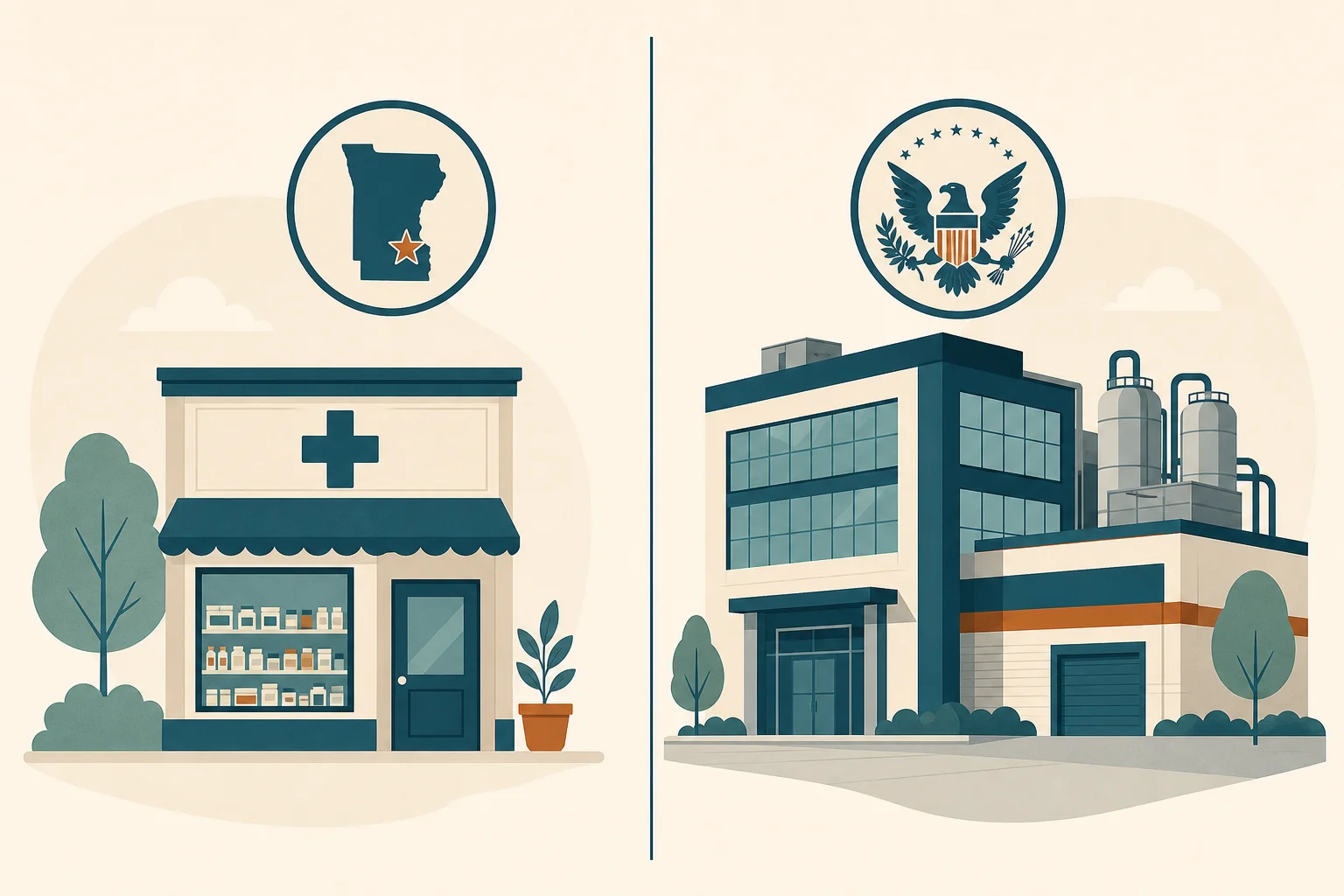
When a telehealth provider advertises “503B-quality compounded semaglutide,” they are using two words from a federal statute to mean something the statute does not say. This is not a minor marketing nuance. It is the difference between a pharmacy that is federally registered, FDA-inspected, and currently authorised to produce the drug — and one that is voluntarily adopting some of the same testing practices, while operating under a completely different legal framework, at a moment when the first type of pharmacy has no legal authority to compound these drugs at all.
This article explains both frameworks, how they diverged in the compounded GLP-1 market, and what authority — if any — each one currently holds.
The statute: one law, two tiers
The 503A and 503B designations both trace to the same federal law: the Drug Quality and Security Act of 2013 (DQSA), signed into law after a fungal meningitis outbreak killed 64 patients and injured hundreds more. The outbreak was traced to a New England compounding pharmacy that had been producing sterile injectable drugs at industrial scale under state-pharmacy-board oversight alone. Congress concluded the oversight framework had not kept pace with the actual scale of the industry.
DQSA created a voluntary federal tier — the Section 503B outsourcing facility — that could legally produce sterile drugs in bulk, without patient-specific prescriptions, if the facility accepted FDA registration, current Good Manufacturing Practice (cGMP) compliance, and regular FDA inspections. State-licensed 503A compounding pharmacies kept their traditional model: compound for individual patients, one prescription at a time, under state pharmacy board oversight.
The two tiers were not designed to be interchangeable. They answered two different problems.
503A at a glance
A 503A pharmacy is what most people picture when they think of a compounding pharmacy: a licensed pharmacist receives a prescription for an identified patient, compounds a dose or course tailored to their specific needs, and dispenses it directly to them or their clinic. Key characteristics:
- Prescription required for an identified individual patient before compounding begins
- State-board oversight as the primary regulatory layer; follows USP General Chapter <797> for sterile compounding
- Scale: patient-by-patient; cannot legally produce large speculative batches for general distribution
- Testing: not federally required to test every batch for sterility or potency before dispensing, though many high-quality 503A pharmacies run these tests voluntarily
- Adverse-event reporting: not required to report to FDA
- FDA inspections: not subject to routine federal inspection; state boards conduct periodic reviews
503B at a glance
A 503B outsourcing facility accepted federal oversight in exchange for something 503A pharmacies cannot do: produce drugs at scale without waiting for individual prescriptions. Key characteristics:
- No patient-specific Rx required to compound; can produce large batches for distribution to hospitals, clinics, and healthcare providers
- FDA-registered as an outsourcing facility; this registration is public and searchable on FDA’s website
- cGMP-equivalent standards: validated manufacturing processes, cleanroom requirements, and documentation equivalent to a pharmaceutical manufacturer
- Mandatory batch testing: every single lot must pass sterility testing (no bacteria or fungi), endotoxin testing (no fever-causing bacterial byproducts), and potency testing (dose is what the label states)
- FDA inspections: regular, unannounced facility inspections; deficiencies can trigger voluntary recalls or Form 483 citations on the spot
- Adverse-event reporting: required to report to FDA
These are not cosmetic differences. The accountability structure of 503B is fundamentally different from 503A. A 503B inspection finding has immediate federal regulatory weight. A 503A quality failure gets routed to a state pharmacy board.
What both frameworks need to compound a GLP-1
Neither 503A nor 503B pharmacies have a blanket right to compound any FDA-approved drug they choose. The FD&C Act imposes critical restrictions on compounding commercially available products.
For 503A pharmacies, §503A(b) permits compounding of a commercially available approved drug only when:
- The drug appears on FDA’s drug shortage list at the time of compounding, or
- A licensed prescriber documents that the compounded version produces a significant difference for a specific identified individual patient — for example, a non-standard dose strength, a preservative-free formulation, or a clinically justified additive the patient medically requires
For 503B outsourcing facilities, §503B(a)(2) permits compounding of commercially available approved drugs when:
- The drug is on FDA’s shortage list at the time of compounding, or
- The bulk drug substance used to compound it appears on the 503B Bulk Drug Substances list — a formal FDA-maintained roster identifying substances for which there is a recognised clinical need for outsourcing-facility compounding
Both of those 503B pathways require an affirmative FDA determination. They cannot be asserted unilaterally by a compounder.
The shortage window and what it opened
Between 2022 and early 2025, both semaglutide and tirzepatide were on FDA’s drug shortage list. Demand for GLP-1 weight-loss medications had outpaced Novo Nordisk’s and Eli Lilly’s manufacturing capacity. During this period the shortage-based authority was legally triggered for both 503A and 503B pharmacies.
The scale of what followed was extraordinary. Milliman data cited approximately 80 million compounded GLP-1 prescriptions dispensed in 2024 alone. Compounded GLP-1s were estimated to account for roughly 30 percent of total US GLP-1 supply at the market’s peak. Per-month pricing of $200–$300 was common, versus $1,100–$1,350 for brand-name Wegovy or Zepbound.
That window closed in two steps:
October 2, 2024: FDA removed tirzepatide from the shortage list. 503A compounding pharmacies faced an enforcement deadline of February 18, 2025; 503B outsourcing facilities faced March 19, 2025.
February 21, 2025: FDA removed semaglutide from the shortage list. 503A pharmacies faced an enforcement deadline of April 22, 2025; 503B outsourcing facilities faced May 22, 2025.
All four deadlines are now in the past.
| Drug | Pharmacy type | Enforcement-discretion window ended |
|---|---|---|
| Tirzepatide | 503A | February 18, 2025 |
| Tirzepatide | 503B | March 19, 2025 |
| Semaglutide | 503A | April 22, 2025 |
| Semaglutide | 503B | May 22, 2025 |
What happened to 503B authority after the shortages ended
This is where the two frameworks diverge sharply — and where a great deal of patient confusion lives.
When the shortage authority expired, the 503B pathway closed completely. Outsourcing facilities cannot compound semaglutide or tirzepatide today under any legal theory because:
- The drugs are not on the shortage list
- Neither semaglutide nor tirzepatide is on the 503B Bulk Drug Substances list
- No court has reinstated the authority
- FDA proposed on April 30, 2026 to permanently exclude semaglutide, tirzepatide, and liraglutide from the 503B Bulk Drug Substances list
The Outsourcing Facilities Association filed federal lawsuits challenging FDA’s shortage determinations in October 2024 (tirzepatide) and early 2025 (semaglutide). Courts denied preliminary injunctions in both cases. The enforcement deadlines held. The OFA’s appeals continue in the Fifth Circuit, but as of May 2026 no court has reversed the FDA’s determinations.
A 503A pathway remains narrowly open via the §503A(b)(1)(D) significant-difference provision. That provision requires a licensed prescriber to document a specific patient need that the FDA-approved product cannot meet, and the compounded version must differ meaningfully from the commercial product in a clinically relevant way — not merely in dose for the convenience of a standard titration schedule. FDA's compounding-policy clarification also caps a pharmacy at four or fewer prescriptions per calendar month for products that are essentially copies of a commercially available approved drug (FDA).
FDA has been aggressive in defining the outer boundaries. Over 85 warning letters were issued in two waves during 2025, and parallel manufacturer litigation from Novo Nordisk and Eli Lilly against telehealth providers is active. The core legal question — whether mass “personalised dose” prescriptions qualify as individual patient compounding or constitute commercial-scale production using statutory language as a shield — is being decided in federal courts.
The “503B quality” problem explained precisely
A question we see constantly in patient forums and provider marketing materials: my telehealth company says they use a ‘503B-quality’ or ‘503B-standard’ pharmacy — does that mean I’m getting 503B-compounded medication?
The answer is no. And the distinction matters more in 2026 than it did two years ago.
What the phrase accurately means: A 503A pharmacy that voluntarily adopts the testing protocols that 503B facilities are required to follow — sterility testing, endotoxin testing, potency testing via certificate of analysis — can reasonably describe itself as meeting “503B standards” in practice. Many high-quality 503A pharmacies do exactly this. It is a quality claim about their voluntary testing practices.
What the phrase does not mean: The pharmacy is not registered with FDA as a 503B outsourcing facility. It is not subject to routine FDA inspection. It does not have the legal authority that 503B registration would confer. Its voluntary testing is not verified through the federal inspection process that backs the 503B designation.
Why this matters now, specifically: In the post-shortage landscape, no 503B outsourcing facility legally has authority to compound semaglutide or tirzepatide. So any provider currently offering compounded GLP-1 injections is doing so through a 503A pharmacy — which operates under state-board oversight, not FDA registration. The phrase “503B quality” in that context describes testing practices at a 503A facility, not a 503B facility’s product. That is a meaningful difference from what the words suggest.
A legitimate 503A pharmacy offering rigorous voluntary testing is genuinely preferable to one that does not test at all. But calling it “503B quality” without clarifying that the compounding is happening at a 503A pharmacy under a narrow individual-patient exception is a framing choice that obscures more than it reveals.
The clinical-need exception: what “personalised dose” actually requires
The surviving 503A pathway has a specific statutory name and specific requirements. Under §503A(b)(1)(D):
- A licensed prescriber must determine that a compounded version is necessary to produce a significant difference from the commercial product for that specific patient
- That determination must be based on an individual patient’s documented clinical need, not a population-level preference for lower cost or a different delivery format
- The prescription must identify the individual patient by name
Academic and legal analysis published in the peer-reviewed literature notes that formulations with genuinely documented clinical justifications — preservative-free preparations for patients with demonstrated sensitivity, non-standard dose strengths for titration protocols not achievable with commercial auto-injector pens, or adjunctive combinations for patients with specific comorbidities — are more legally durable under this provision than generic “personalised dose” labels applied at the point of a telehealth checkout (PMC/NCBI, 2025).
The legal exposure for providers lies in scale. If a 503A pharmacy is compounding “personalised” semaglutide for tens of thousands of patients all at the same standard dose, and prescribers are documenting similar boilerplate clinical rationale, FDA’s position is that this is industrial-scale production wearing individual-patient-compounding language as a label. That is the core of both the warning-letter campaigns and the manufacturer lawsuits.
The April 30, 2026 proposed rule: closing the door permanently
On April 30, 2026, FDA published a proposed rule to permanently exclude semaglutide, tirzepatide, and liraglutide from the 503B Bulk Drug Substances list. The public comment period runs through June 29, 2026.
The legal significance: the 503B Bulk Drug Substances list is the only mechanism by which an outsourcing facility could compound a commercially available approved drug even when no shortage exists, if FDA has determined there is a recognised clinical need for bulk compounding. If FDA finalises this rule, it eliminates that future pathway entirely. Even if either drug returned to shortage, a 503B facility would need a separate rulemaking process to get back on the list.
FDA’s stated rationale rejected cost as a basis for the clinical-need determination: “supply-related issues like backorders are not what the statute means by clinical need.” The agency framed access and affordability as “a different problem with a different set of policy tools” — positioning pricing as a payer, Medicare, and manufacturer concern, not an FDA manufacturing issue.
If finalised, this proposal makes permanent what the shortage resolutions achieved temporarily. The regulatory door for mass-market compounded GLP-1 production would be bolted rather than merely closed.
What is actually legal today
| Scenario | Legal in 2026? | Notes |
|---|---|---|
| 503B outsourcing facility compounds semaglutide for distribution | No | Shortage ended Feb 2025; not on bulks list; all deadlines passed |
| 503B outsourcing facility compounds tirzepatide for distribution | No | Shortage ended Oct 2024; same analysis |
| 503A compounds standard-dose semaglutide without individual documentation | No | No shortage authority; no individual clinical-need documentation |
| 503A compounds for a specific patient with documented preservative allergy | Narrow/contested | §503A(b)(1)(D) may apply with proper prescriber documentation |
| 503A compounds non-standard dose with genuine individual clinical rationale | Narrow/contested | Same provision; requires genuine individual documentation, not boilerplate |
| FDA-approved Wegovy, Ozempic, Zepbound, or Mounjaro | Yes | Only currently unambiguous option; price gap has narrowed significantly |
The price context has changed
One reason the regulatory question feels less operationally urgent than in 2024 is that the price gap between compounded and branded GLP-1s has narrowed substantially. Novo Nordisk and Eli Lilly both introduced self-pay programs with reduced pricing:
- Wegovy via NovoCare self-pay: approximately $349/month with introductory rates available for lower doses
- Zepbound vials through LillyDirect: approximately $299–$449/month depending on dose
- Ozempic through manufacturer coupon programs: variable but significantly reduced from peak list pricing
The compounded market’s price advantage was compelling when brand prices sat at $1,100–$1,350/month. The arithmetic at $349–$449/month is different. Whether the remaining price differential justifies the legal and quality uncertainties of compounded semaglutide versions is a decision individual patients must make with their prescribers — but it is a decision with fewer obvious answers than it carried in 2023. For a full look at the legal low-cost options still available, see our cheap GLP-1 alternatives guide.
Questions to ask any provider making 503B claims
If a provider or pharmacy uses “503B” language in their marketing, three questions cut through:
“Is your compounding pharmacy actually registered with FDA as a 503B outsourcing facility?” Ask for the FDA registration number. FDA’s list of registered outsourcing facilities is publicly searchable at fda.gov. If they cannot provide a registered facility number, they are a 503A pharmacy regardless of how their marketing reads. For definitions of terms like “503A,” “503B,” and “bulk drug substance,” see our compounding glossary.
“If you are a 503B facility, what is your current legal basis for compounding semaglutide or tirzepatide?” Valid answers in 2026 are narrow. If they reference shortage status, that authority lapsed in 2025. If they reference the bulk substances list, these drugs are not on it. If they cannot answer specifically, that is informative.
“If you are a 503A pharmacy describing 503B-quality practices, what do you test and when?” A genuine quality claim should specify the COA process: sterility testing frequency, potency testing methodology, and when in the batch process testing occurs. Vague references to “pharmaceutical-grade” without specifics are marketing, not a quality assurance program description.
The full timeline of how the compounded GLP-1 market contracted — including the Outsourcing Facilities Association litigation, the FDA warning-letter waves, and the Hims–Novo settlement — is at our compounding cliff timeline. Current operating status of specific providers is at the compounding tracker. If you are considering moving from a compounded product to a branded one, the clinical and logistical considerations are at switching from compounded to brand. If you are still trying to work out what compounded supply legitimately remains in 2026, see where to get compounded semaglutide in 2026.
If you spot an error or a missing source in this article, email [email protected]. We update this page on any material FDA publication, proposed rule, or federal court ruling affecting the 503A/503B framework for GLP-1s.
Frequently asked questions
What is the main difference between a 503A pharmacy and a 503B outsourcing facility?
503A pharmacies are state-licensed, compound drugs for individual patients on a valid prescription, and must personalise each compound in some clinically meaningful way. 503B outsourcing facilities are FDA-registered, can compound at commercial scale without patient-specific prescriptions, must meet cGMP-equivalent quality standards, and are subject to routine FDA inspection rather than state-board review alone. Both frameworks trace to the Drug Quality and Security Act of 2013.
Can a 503B outsourcing facility still compound semaglutide or tirzepatide in 2026?
No. 503B authority to compound commercially available approved drugs requires either shortage-list status or an approved entry on the 503B Bulk Drug Substances list. Tirzepatide left the shortage list on October 2, 2024; semaglutide on February 21, 2025. Neither is on the permanent bulks list. The May 22, 2025 enforcement deadline has passed. FDA's April 30, 2026 proposed rule would permanently exclude semaglutide, tirzepatide, and liraglutide from that list.
Can 503A pharmacies still legally compound semaglutide for individual patients?
In narrow circumstances, yes. Under §503A(b)(1)(D) of the FD&C Act, a state-licensed 503A pharmacist may compound a commercially available approved drug for an identified individual patient when a licensed prescriber documents that a compounded version produces a significant difference for that specific patient — for example, a preservative-free formulation, a non-standard dose, or a clinically justified additive. Standard-dose copies marketed primarily on price do not qualify. FDA has issued over 85 warning letters to providers it believes are stretching this exception.
What does '503B quality' or '503B-standard' mean when a provider uses that phrase?
It describes a testing and manufacturing practice adopted at a 503A pharmacy, not a registration status. A 503A pharmacy can voluntarily run the same sterility, endotoxin, and potency tests that 503B facilities are required to do, and marketing language like '503B quality' or 'outsourcing-facility standards' refers to those voluntary practices. It does not mean the pharmacy is federally registered as a 503B outsourcing facility or subject to routine FDA inspection. In 2026, no 503B outsourcing facility has legal authority to compound semaglutide or tirzepatide, so any provider currently offering compounded GLP-1 injections is operating through a 503A pharmacy regardless of how they frame it.
Why did the shortage status matter so much for compounding authority?
Under the FD&C Act, §503A allows compounding of commercially available approved drugs only when that drug is on FDA's drug shortage list or when an individual patient's prescriber documents a significant clinical need for a specific non-standard formulation. §503B has two pathways: shortage-list status, or placement on the 503B Bulk Drug Substances list. When FDA removed tirzepatide from shortage (October 2024) and semaglutide (February 2025), both shortage-based authorities evaporated. The Bulk Drug Substances pathway was never triggered for GLP-1s and FDA's April 2026 proposal would close it permanently.
What was the Drug Quality and Security Act and why did it create two tiers?
Congress passed DQSA in 2013 following a fungal meningitis outbreak traced to a New England compounding pharmacy that killed 64 people. The law created the 503B outsourcing facility category — a voluntary, FDA-registered tier that could serve hospitals and clinics at scale in exchange for accepting cGMP oversight and FDA inspection. 503A traditional compounding pharmacies kept their state-board model with patient-specific prescription requirements intact. The two-tier system separated small-scale personalised compounding from what had become quasi-industrial drug manufacturing.
What legal challenges have outsourcing facilities mounted, and have they succeeded?
The Outsourcing Facilities Association filed federal lawsuits challenging FDA's shortage determinations for tirzepatide and semaglutide in October 2024 and early 2025. Courts denied preliminary injunctions in both cases and the enforcement deadlines held. The OFA's appeals continue in the Fifth Circuit. As of May 2026 no court has reinstated the compounding authority. FDA's April 30, 2026 proposed rule, if finalised, would eliminate the 503B pathway even if a future shortage recurred.
If I want the highest regulatory certainty for semaglutide or tirzepatide, what are my options?
FDA-approved branded products — Wegovy, Ozempic, Zepbound, or Mounjaro — are the only option with full regulatory assurance. Both Novo Nordisk and Eli Lilly have introduced self-pay programs that have substantially narrowed the price gap: Wegovy vials are available via NovoCare at reduced rates and Zepbound vials through LillyDirect start at approximately $299–$449 per month depending on dose. Any compounded version in 2026 carries legal and quality uncertainty that branded products do not.