Eden Semaglutide Review (2026): Pricing, Safety, and Complaint Record
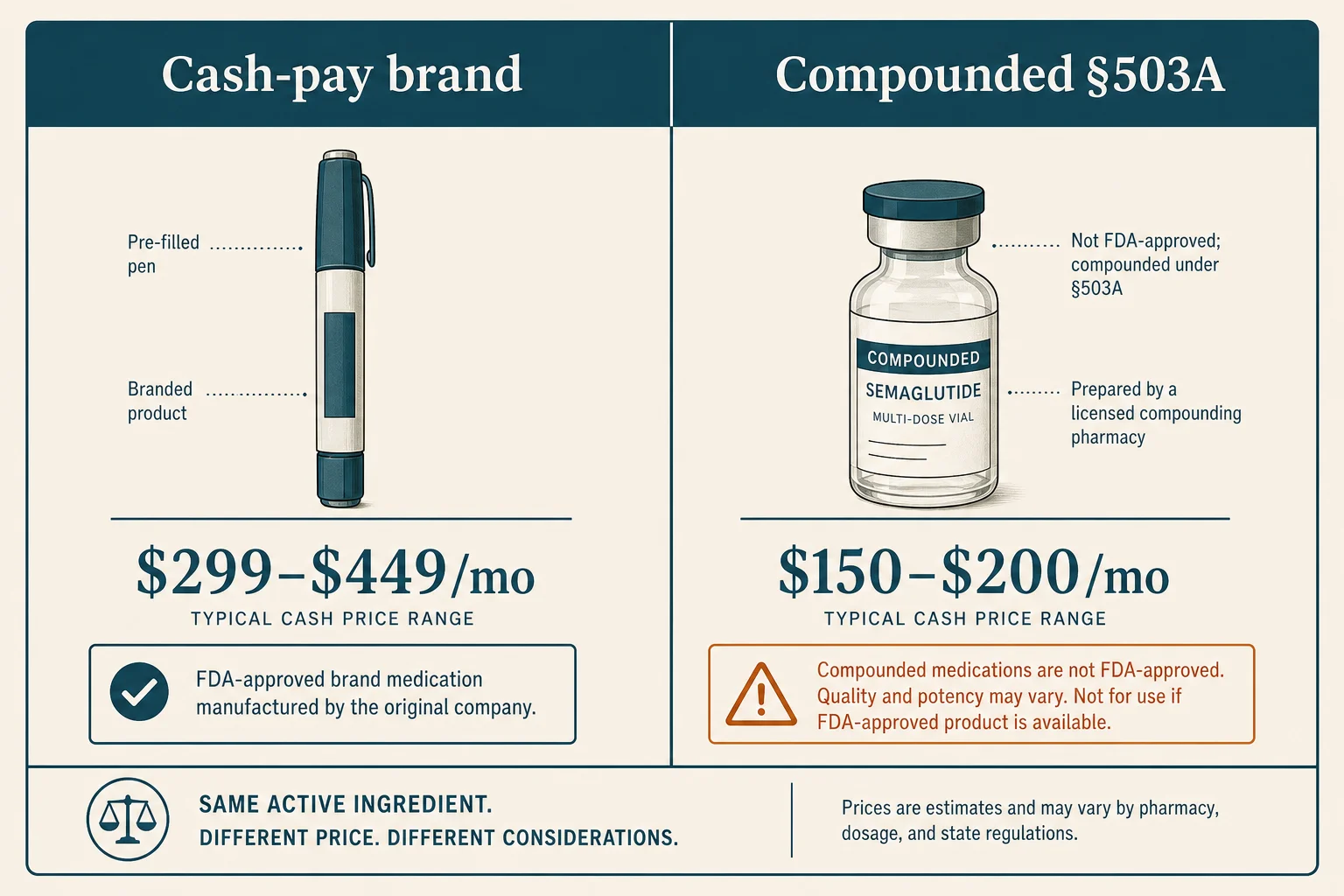
You are looking for the lowest-cost legal compounded GLP-1 option from a telehealth platform that is still running as of 2026. Eden is on most short lists for that search. It prices below the better-known providers, it has a named clinical team, and it has not received an FDA warning letter. It also carries every risk that every remaining compounding provider carries — and that risk is worth understanding before you enroll.
This review covers what Eden actually offers, what it costs, how the intake works, what patients report about the support experience, and how the regulatory picture looks as of May 2026. It is built from Eden’s published program materials, independent review sites, public patient accounts, and FDA records. A hands-on editorial sign-up will be added as a dated block when complete.
Disclosure: Eden operates a high-commission affiliate program. Metabolic Ledger does not accept affiliate payments from any provider we review. Sources and methodology at /editorial-policy.
Eden at a glance
| Model | Cash-pay compounded GLP-1 telehealth |
| Founded | 2020 |
| Members served | 50,000+ (company-reported) |
| LegitScript certified | Yes |
| Compounding status (May 2026) | Operational — §503A(b)(1)(D) framing |
| FDA warning letter received | No (as of May 2026) |
| Single-pathway tier (GLP-1) | $209/month all-in, flat |
| Dual-pathway tier (GLP-1 + GIP) | $329/month all-in, flat |
| Dose-based price escalation | No — flat pricing at all dose levels |
| Insurance accepted | No |
| HSA/FSA accepted | Yes |
| Telehealth model | Asynchronous prescriber; unlimited messaging |
| Ships to | All 50 states (company-reported) |
| Money-back guarantee | 10% body weight in 6 months (terms apply) |
Pricing from Eden’s published rates as of May 2026. Verify before enrolling — Eden adjusts pricing.
How we review providers: every platform is scored against the same five-question review methodology. Metabolic Ledger is reader-supported — we may earn a commission if you start a programme through some links, at no extra cost to you (affiliate disclosure). This is an editorial review, not medical advice.
Eden in 2026 — the compounding-status reality
The most important question about any compounded GLP-1 provider in 2026 is not “does it ship quickly?” It is “will it still be operating in six months?” Here is where Eden stands.
The §503A(b)(1)(D) framing
The FDA declared the semaglutide shortage resolved on February 21, 2025. The tirzepatide shortage was resolved on October 2, 2024. Once the shortage declarations lapsed, the statutory basis for mass-market compounding under the emergency shortage-era rules ended. The enforcement-discretion windows FDA extended to 503A and 503B operators expired by May 22, 2025.
Eden, like Henry Meds and other remaining operators, now operates under a different statutory clause: §503A(b)(1)(D) of the Federal Food, Drug, and Cosmetic Act. This clause permits a state-licensed 503A compounding pharmacy to prepare a drug for an identified individual patient when the prescriber documents that a modification from the FDA-approved product produces a “significant difference” for that patient. In practice this is implemented through personalised dose levels, additives (commonly B12), or combination formulations that differ from what commercially available Wegovy or Zepbound offer.
Eden’s four named compounding pharmacy partners — GoGoMeds, Precision, Enovex, and Absolute Pharmacy — are all described as PCAB-accredited 503A facilities operating under this framework.
What the FDA has said in 2026
On March 3, 2026, FDA issued 30 warning letters to telehealth companies for illegal marketing of compounded GLP-1s. The violations cited were primarily mislabelling — companies placing their own brand names on labels in a way that implied they compounded the drugs themselves — and marketing claims that implied FDA approval or equivalence. Eden was not publicly identified as a recipient of those letters. The FDA’s April 2026 clarification on 503A compounding further specified that a 503A pharmacy may compound semaglutide for an individual patient if the prescriber documents a significant difference — but cautioned against scale operations that replicate brand drugs without documented clinical justification.
Eden has not received an FDA warning letter as of May 2026. We verify this against the FDA warning-letter database monthly and will update this page when that status changes.
The continuity risk, stated plainly
503A patient-specific compounding is still legal. What is not settled is whether providers operating at volume — using the §503A(b)(1)(D) framing across tens of thousands of patients — will face FDA enforcement or brand-manufacturer patent suits that force a programme wind-down. Hims wound down under a Novo Nordisk settlement. Eden has not. That is meaningful, but it does not immunise Eden from a similar action. If continuity over a 12-month-plus treatment horizon is essential for you, the branded path (Wegovy via NovoCare, Zepbound via LillyDirect) removes the legal-continuity variable.
Pricing — what Eden actually costs
Eden restructured its pricing in September 2026. It no longer sells by drug with a discounted first month; it sells two programme tiers at a flat monthly price, which it advertises as “one monthly price, guaranteed for life.”
| Tier | Monthly | What it covers |
|---|---|---|
| Most Popular | $209/month | Single-pathway GLP-1 support |
| Maximum Support | $329/month | Dual-pathway GLP-1 + GIP support |
| Oral semaglutide | ~$246/mo | Listed separately from the tiers |
| GLP-1 gummies (quarterly billing) | ~$296/mo | Not compounded injectable semaglutide |
What the tiers mean
The two tiers map onto the underlying molecule rather than the brand. Single-pathway is GLP-1 receptor agonism, which in practice means compounded semaglutide. Dual-pathway adds GIP, which means compounded tirzepatide. Eden markets them by mechanism rather than by drug name.
Pricing is flat regardless of dose, so titrating from a starter dose to maintenance does not change what you pay. There is no first-month discount any more, and no separate platform fee.
The “guaranteed for life” framing refers to the price being held for as long as you stay on the programme continuously. It is a retention mechanism: it rewards staying and resets if you lapse. Check Eden’s current terms for what counts as a break in continuity before relying on it.
Pricing changed in September 2026. Anything describing Eden as charging $129 for a first month and $209 or $329 a month thereafter refers to the old per-drug structure and is out of date — including earlier versions of this page.
Oral semaglutide
Eden also offers an oral semaglutide formulation. Published pricing runs approximately $196 first month, then $246/month — positioned as an alternative for patients who prefer oral over injectable.
GLP-1 gummies
Eden has expanded its formulary to include GLP-1 gummies at approximately $296/month, though this product is sold on a quarterly billing cycle. The gummy formulation is not compounded injectable semaglutide; verify the formulation specifics with Eden’s clinical team before ordering.
What the price includes
Eden’s published price covers: the prescriber evaluation, prescription issuance, ongoing provider messaging (described as unlimited), dose-adjustment support, and free expedited shipping. There is no separate platform fee layered on top of the medication cost.
Comparative pricing context
| Provider | Compounded semaglutide (monthly) | Compounded tirzepatide (monthly) |
|---|---|---|
| Eden | $209/month (all-in) | $329/month (all-in) |
| Henry Meds | ~$297–$349 | ~$349–$449 |
| Mochi (cash-pay) | from $60 + $79 membership | from $90 + $79 membership |
| NovoCare (branded Wegovy) | $349 flat | N/A |
| LillyDirect (branded Zepbound) | N/A | $399–$449 |
Eden’s ongoing price of $209/month for compounded semaglutide is the most competitive published rate among major 503A compounding providers as of May 2026. The NovoCare branded path at $349/month costs $140 more per month but delivers the FDA-approved drug with no compounding-continuity risk. For a 12-month treatment horizon, that is roughly $1,680 in cost difference — a real number, alongside a real risk differential.
Sign-up and intake
How it works
Eden’s sign-up flow is fully online. You complete a medical history questionnaire covering weight, BMI, existing medications, contraindications (including thyroid carcinoma history, pancreatitis, and GI conditions), and weight-loss goals. An Eden-affiliated prescriber reviews the intake asynchronously and determines eligibility.
BMI thresholds match FDA-approved indications: BMI ≥ 30, or BMI ≥ 27 with at least one weight-related comorbidity (hypertension, type 2 diabetes, dyslipidaemia). If you are not approved, you are not charged for the visit.
Timeline from sign-up to first dose
Based on public patient accounts, the intake-to-prescription step takes 24–48 hours. After prescription issuance, Eden’s partner pharmacies process and ship, typically arriving within 5–10 business days for most states. Eden markets “free expedited shipping” and some patient accounts describe next-day shipping after prescription processing. The Bariatric Journal review noted that Eden ships via styrofoam with cold packs rather than medical-grade refrigeration, relying on expedited transit to maintain temperature integrity. That is standard for most compounding telehealth shippers.
Lab work requirement
Lab work is not required upfront on Eden’s base plan. This is common across budget compounding platforms and contrasts with more clinically comprehensive programmes. If you have existing labs, you can submit them; if you have no recent labs, you can proceed without.
Formulary (May 2026)
Eden’s current GLP-1 compounded formulary:
Compounded injectable semaglutide — weekly self-injection; dose titration from starter through maintenance; B12 typically included as a documented additive. This is the product most patients are purchasing.
Compounded oral semaglutide — oral tablet format; dosing as prescribed. Less data available on long-term patient outcomes versus injectable.
Compounded tirzepatide — dual GIP/GLP-1 agonist; same legal framing as semaglutide.
GLP-1 gummies — quarterly billing; verify formulation details before ordering.
Brand-name options — Eden also lists brand-name Ozempic, Wegovy, Mounjaro, Victoza, and Zepbound on its site at $189–$1,695/month. These are telehealth-mediated paths to FDA-approved branded products, not compounded medications. For most patients comparing Eden to other telehealth providers, the relevant products are the compounded semaglutide and tirzepatide.
Verify the current formulary directly at Eden before enrolling. Formulary offerings have shifted across 2025–2026 as the regulatory environment has changed.
Support quality — what patients actually report
Eden markets “US-based human support (not bots)” and “unlimited provider messaging” as distinguishing features. The clinical team includes publicly named staff: Dr Rebecca Emch (VP of Pharmacy Operations) appears in Eden’s own educational content, and Dr Halland Chen and Dr Matthew Bennett serve in medical advisory roles.
What public accounts say
Multiple independent review analyses of Eden’s public Trustpilot record (approximately 2,000 reviews; 3.8/5 rating) surface consistent themes:
Patient accounts praise responsive customer service staff and generally smooth refill processes. One representative Trustpilot comment referenced a representative named Xyryl for “prompt responses and great customer service.” Another patient described being “thoughtfully walked through the process and options to get medication quicker” despite high demand periods.
Recurring complaints include: shipping address issues causing delivery problems; billing concerns on quarterly products; and the patient portal being “clunky” by some accounts. Weekend support response times can extend to 20–28 hours.
Provider consistency across visits is a concern noted in some reviews — with an asynchronous model, you may not interact with the same prescriber for every check-in.
Eden’s leadership reportedly responds personally to Trustpilot complaints, which is a positive signal on accountability.
What Reddit says
The r/Semaglutide community has automated moderation that restricts discussion of non-FDA-approved compounded semaglutide, which limits organic Eden-specific threads in those subreddits. What we can pull from aggregated public accounts:
Eden appears more often in comparison queries (“Eden vs Henry Meds”, “lowest cost compounded sema”) than in standalone experience threads — consistent with it being a platform patients choose primarily on price rather than community reputation. The absence of widespread complaints in structured searches is a mild positive signal, but the sub restrictions mean absence of Reddit signal is not definitive.
The no-offboarding gap
One point the Bariatric Journal review flags is worth repeating: Eden does not offer structured transition support when you stop the programme. When you cancel, you get your prescription records and that is it. There is no nutritional counselling, no maintenance-dose taper guidance, no transition path built into the platform. For a treatment that most patients will eventually need to stop or transition off, that is a real gap.
Cancellation — how it works
Cancel through your Eden patient portal, or contact support directly. Cancel before your next billing cycle to avoid a charge for the following shipment. Eden’s billing is monthly by default; the three-month plan auto-renews quarterly.
Under HIPAA, you can request a copy of your prescription, clinical notes, and medical history. That documentation can be transferred to a different prescriber or pharmacy. Eden does not charge a cancellation fee.
If Eden’s programme winds down — due to enforcement or litigation — patients will need to transition to an alternative. The switch-from-compounded-to-brand guide covers that process in detail.
Best for / Not for
Eden is the right starting point if:
- You are a cash-pay patient who wants the lowest published sticker price on compounded semaglutide or tirzepatide
- You are comfortable with an asynchronous, lighter-touch clinical model in exchange for that price
- You want a quick intake with no insurance verification step and no upfront lab requirement
- You want flat pricing that does not escalate as you move up in dose
Eden is not the right fit if:
- You have commercial insurance that covers Wegovy or Zepbound — the branded path beats Eden’s compounded price once insurance is factored in
- You want a high-touch clinical relationship with a consistent prescriber
- You need certainty of uninterrupted supply over a 12-plus month horizon — compounding-continuity risk is real
- You want the FDA-approved product specifically
Eden vs Henry Meds — brief comparison
Both Eden and Henry Meds are compounding-focused telehealth platforms operating under the §503A(b)(1)(D) framing as of May 2026. Neither has received an FDA warning letter. The comparison:
| Eden | Henry Meds | |
|---|---|---|
| Compounded semaglutide (ongoing) | $209/month | ~$297–$349/month |
| Compounded tirzepatide (ongoing) | $329/month | ~$349–$449/month |
| Dose-based price escalation | No | Yes |
| Money-back guarantee | Yes (10% in 6 months) | Not prominently offered |
| Named pharmacy partners | Yes (GoGoMeds, Precision, Enovex, Absolute) | 503A network (specific names less prominent) |
| Clinical framework depth | Lighter-touch, lower price | More developed published clinical content |
| Insurance navigation | No | No |
| Ships to | All 50 states | Most US states |
Bottom line: Eden leads on price; Henry leads on published clinical depth and programme structure. Both carry the same legal-continuity risk. If minimising monthly cost is the priority, Eden has the sharper pencil. If you want a more developed prescriber relationship, Henry is the stronger platform. See Henry Meds review for the full Henry Meds assessment.
The 10% money-back warranty
Eden offers a 10% body-weight loss guarantee within six months, with a refund if the target is not met following the plan. This is an unusual feature in the compounding telehealth space. Conditions apply — adherence documentation is required — but the existence of an outcome-based guarantee is a meaningful signal. It implies Eden has enough confidence in typical outcomes to back them financially. Read the full terms before relying on this as a primary purchasing criterion.
Third-party ratings and complaint record (August 2026)
We checked Eden's public ratings on 18 August 2026. Trustpilot shows 4.5/5 across roughly 4,500 reviews. The Better Business Bureau tells a different story: Eden's Denver BBB profile carries an F rating, and the stated reason is that 84 of the 109 complaints on file received no response from the company. A high Trustpilot score sitting next to an F for unanswered formal complaints is a pattern worth reading correctly — satisfied subscribers post to Trustpilot, while unresolved billing and cancellation disputes escalate to the BBB and go quiet. It does not make Eden a scam; it does mean that if something goes wrong, you should not count on the complaint process to fix it. Pay by a method you can dispute, and keep every confirmation email.
Sources: Trustpilot, BBB profile — both checked 18 August 2026.
What we are watching
Two things are most likely to change:
Eden’s compounding-operations status. A warning letter, lawsuit filing, or court ruling could change the situation quickly. We update this review monthly and will flag any change to Eden’s status at the top of this page when it occurs. The compounding tracker lists current status across all providers.
Pricing. Eden has adjusted its price structure repeatedly as the market has shifted through 2025–2026, most recently in September 2026 when it dropped per-drug pricing for the two all-in tiers. The $99 and $129 tier pricing is current as of this writing; verify at Eden before enrolling.
For the regulatory backdrop, see the FDA compounding cliff timeline. For an alternative if Eden’s status changes, see the switch-from-compounded-to-brand guide. For a side-by-side comparison across all major providers, see the provider compare table.
Built from public sources including Eden’s published programme materials, independent review analyses, FDA public records, and public patient accounts as of May 2026. This is an editorial-only review; it is not clinical advice. If you spot an error or a missing source, email [email protected].
Frequently asked questions
Is Eden Weight Loss legit?
Eden is a licensed US telehealth company operating through state-licensed medical providers and partner 503A compounding pharmacies. It is LegitScript-certified and has served over 50,000 members. It is not a scam. Whether its compounded GLP-1 program will remain operational throughout a patient's treatment horizon is the open question — that depends on enforcement and litigation developments Eden does not control.
Is Eden still compounding semaglutide in 2026?
Yes, as of May 2026. Eden operates under the §503A(b)(1)(D) significant-difference framing used by other remaining compounding providers. Eden has not received an FDA warning letter as of this writing. We verify this monthly and will update this page if that changes.
What does Eden compounded semaglutide cost?
Since September 2026 Eden sells two all-in programme tiers rather than per-drug prices: $99/month for single-pathway GLP-1 support and $129/month for dual-pathway GLP-1 + GIP. There is no separate first-month rate and no per-dose escalation. The older $129-then-$209 semaglutide structure no longer applies. Verify current pricing on Eden's site before enrolling.
Does Eden work with insurance?
No. Eden is a cash-pay platform. Compounded medications from 503A pharmacies cannot be billed to insurance. Eden does not offer insurance navigation or prior-authorization assistance. HSA and FSA cards are accepted.
How do I cancel Eden and what happens to my prescription?
Cancel through your Eden patient portal or by contacting support before your next billing cycle. Your prescription and clinical records are yours under HIPAA — you can request copies and transfer them to another provider or pharmacy. Eden does not provide structured transition counseling when you stop the program.
Will Eden wind down like Hims did?
That depends on whether Novo Nordisk or Eli Lilly file a patent-infringement lawsuit against Eden specifically, and whether FDA takes targeted enforcement action. Eden was not among the named defendants in Novo Nordisk's February 2026 omnibus suit. It has remained operational through the enforcement waves that ended Hims's compounded program. The risk is real and cannot be predicted with precision.
What compounding pharmacies does Eden use?
Eden publicly names four PCAB-accredited 503A compounding pharmacy partners: GoGoMeds, Precision, Enovex, and Absolute Pharmacy. All four are described as FDA-registered facilities that undergo third-party testing. Which pharmacy fulfills your specific prescription is disclosed at prescription time.
How does Eden compare to Henry Meds on price?
Eden is markedly cheaper at the sticker level since its September 2026 restructure. Eden's single-pathway tier is $99/month all-in versus Henry Meds' approximately $297–$349/month, and its dual-pathway tier is $129/month versus $349–$449/month. Both operate under the same 503A legal framing. Henry Meds has a more developed published clinical framework; Eden leads on price by a wide margin.