Henry Meds Review: GLP-1 Compounding Specialist (2026)
Henry Meds is one of the few telehealth GLP-1 providers that, as of May 2026, is still actively operating a compounded semaglutide and tirzepatide program. Hims wound down under a Novo Nordisk patent suit. Ro transitioned to branded. Henry Meds has not. That fact is either the reason you are reading this review or the first thing this review should address clearly.
This review covers what Henry Meds actually sells, at what price, under what legal framing, and what the sign-up and support experience looks like. It is built from public sources and published pricing; we note where we are relying on published disclosures versus direct testing. This is an editorial-only review — clinical-care scoring is deferred to the post-MD-reviewer phase.
Henry Meds at a glance
| Legal name | Adonis Health Inc., San Francisco CA |
| Founded | 2022 |
| Compounding status (May 2026) | Operational — §503A(b)(1)(D) framing |
| FDA warning letter received | No (as of May 2026) |
| Formulary | Compounded semaglutide (injectable + oral), tirzepatide (injectable + oral), ancillary peptides |
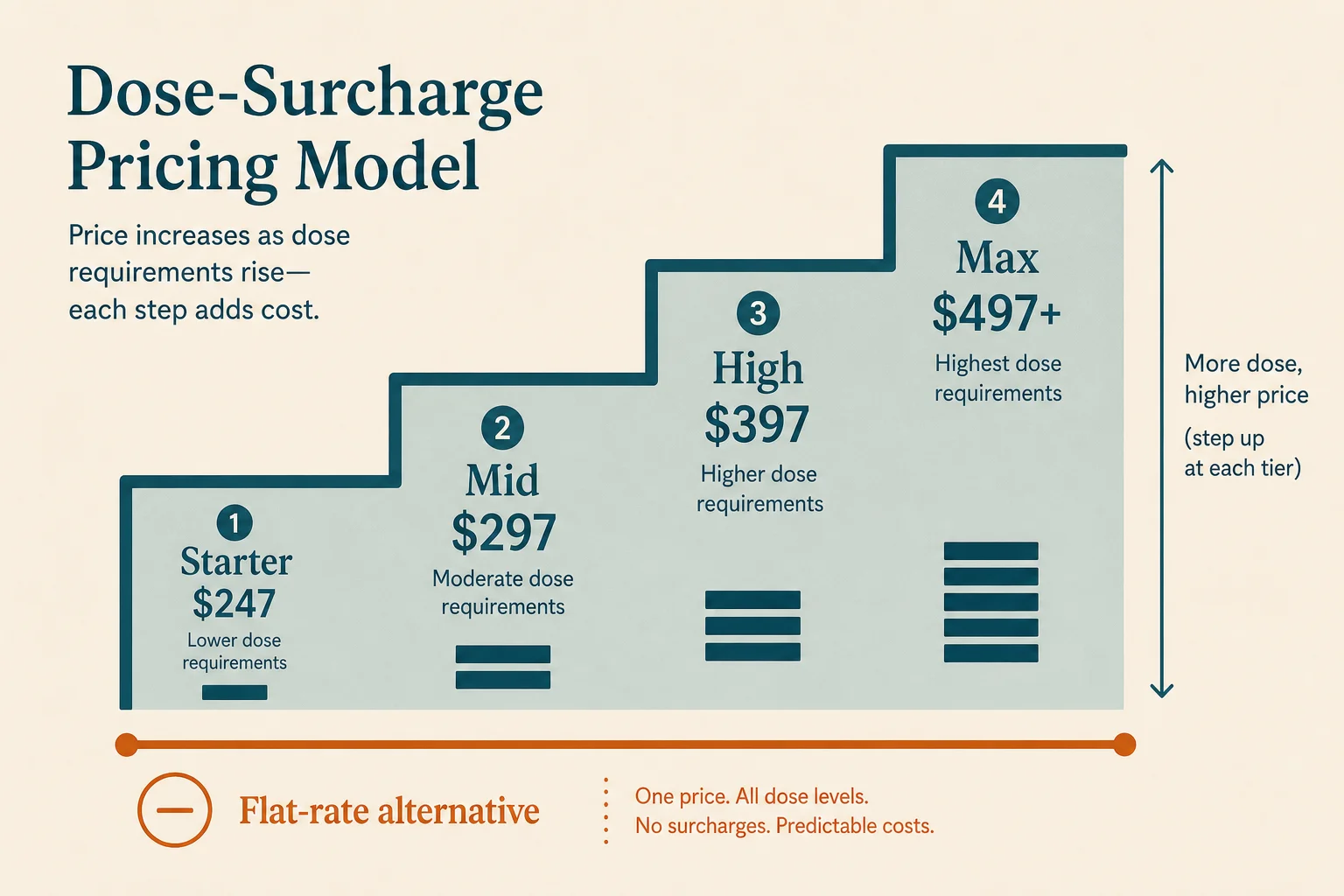
| Cash-pay injectable semaglutide | $247 first month; $297/month recurring (standard dose); +$100/month above standard |
| Cash-pay injectable tirzepatide | $399 first month; $449/month recurring |
| Cash-pay oral semaglutide | $199 first month; $249/month recurring |
| Cash-pay oral tirzepatide | $299 first month; $349/month recurring |
| Insurance accepted | No |
| Telehealth visit model | Asynchronous prescriber; monthly check-ins |
| Ships to | Most US states |
| Trustpilot rating | 4.5 stars (12,000+ reviews) |
| BBB grade | F (192 complaints) |
Henry Meds in 2026 — the compounding-status reality
The most important fact about any compounding-dependent provider in 2026 is their legal status. Here is where Henry Meds stands.
The §503A(b)(1)(D) framing
FDA declared the tirzepatide shortage resolved on October 2, 2024 and the semaglutide shortage resolved on February 21, 2025. Once the shortage declaration lapses, the statutory authority for mass-market compounding of those drugs under the shortage-era rules ends. The enforcement-discretion windows FDA extended to 503A and 503B operators all expired by May 22, 2025.
Henry Meds, like several remaining providers, operates under a different statutory clause: §503A(b)(1)(D) of the Federal Food, Drug, and Cosmetic Act. This clause permits a state-licensed 503A compounding pharmacy to prepare a drug for an identified individual patient when the prescriber determines in writing that a modification from the FDA-approved product produces a “significant difference” for that patient. In practice, this is most commonly implemented as a personalised dose, a B12 or other additive, or a sublingual formulation. For the full regulatory picture, see our Henry Meds compounding status tracker and the compounded vs brand semaglutide guide.
Henry Meds describes this framing publicly as the basis for its continued operation. FDA and the brand manufacturers contend that many providers using this framing are producing at volume in a way §503A(b)(1)(D) was not designed to permit — that true personalised compounding is patient-by-patient, not a template applied to thousands of prescriptions.
Post-cliff operating status
As of May 2026, Henry Meds has not received an FDA warning letter. We check the FDA warning-letter database monthly and will update this page when that changes.
In March 2026, the FDA issued warning letters to more than 50 GLP-1 compounders and manufacturers across the sector — a significant escalation in enforcement activity. Henry Meds has not been confirmed among the recipients in publicly available FDA records as of this writing. An earlier published report incorrectly listed Henry among the recipients; that report was subsequently corrected, per our verification against FDA's public warning-letter database.
The fourteen defendants in Novo Nordisk’s February 2026 patent-infringement suits do not, from public filings, include Henry Meds; those suits are against different named providers. That does not mean Henry is permanently insulated; it reflects the enforcement prioritisation as of this writing.
Legitimacy signals worth noting
Henry Meds operates a named medical director and publishes physician-authored content. Their partner compounding pharmacies are 503A-licensed (state-licensed; not FDA-registered like 503B outsourcing facilities). Henry has published information about their quality-control process and COA (certificate of analysis) availability. Whether that sourcing transparency is adequate is a judgment call; we report what is publicly disclosed, not what is definitively verified.
The company holds a Trustpilot rating of approximately 4.5 stars across more than 12,000 reviews, a signal of broad patient volume and largely positive sentiment. The BBB grade of F with 192 complaints in three years warrants attention, though BBB grades are weighted by response patterns and complaint volume rather than clinical outcomes.
The sign-up and intake experience
Intake form depth
Henry Meds uses an asynchronous intake: you complete a health questionnaire and medical history form, and a Henry-affiliated prescriber reviews it to determine eligibility and issue the prescription if appropriate. The intake form covers contraindications including personal or family history of thyroid carcinoma, pancreatitis, and medication interactions — consistent with the Wegovy and Zepbound prescribing-label contraindications.
Qualification process
BMI eligibility thresholds mirror the FDA-approved indications: BMI ≥ 30, or BMI ≥ 27 with at least one weight-related comorbidity. The prescriber adjudicates eligibility asynchronously. If you are declined, Henry Meds does not charge you for the visit.
Time from sign-up to prescription
Based on published patient accounts and Henry’s own documentation, the intake-to-prescription step typically takes 1–3 business days. After prescription issuance, the compounding pharmacy processes and ships, typically arriving within 3–7 business days from prescription date for most states.
Formulary and pricing (May 2026)
Henry Meds offers both injectable and oral compounded GLP-1 options. Pricing below reflects current published rates; verify directly at Henry’s site before enrolling, as this is one of the fields we update monthly.
Injectable semaglutide
- First month: $247
- Recurring monthly: $297/month at standard dose (up to 1 mg)
- Above-standard dose (above 1 mg, up to max 2 mg): +$100/month, so $397/month at maintenance doses
The dose-based pricing surcharge is a meaningful consideration for long-term patients who reach higher maintenance doses. A patient on a 1.7 mg or 2 mg maintenance dose will pay approximately $397/month — roughly $1,200/year more than the headline price.
Injectable tirzepatide
- First month: $399
- Recurring monthly: $449/month
Oral semaglutide (tablets or sublingual drops)
- First month: $199
- Recurring monthly: $249 at standard dose (up to 1 mg); +$100/month above standard
Oral formulations are available as an alternative for patients who prefer not to self-inject, or who want to begin at a lower price point.
Oral tirzepatide
- First month: $299
- Recurring monthly: $349
Pricing reality
Compounded vs branded cost comparison
| Path | Monthly cost (semaglutide) | Monthly cost (tirzepatide) |
|---|---|---|
| Henry Meds compounded injectable (standard dose) | $297/month | $449/month |
| Henry Meds compounded injectable (above-standard dose) | $397 | $449/month |
| NovoCare direct (Wegovy branded) | $349 | N/A — different drug |
| LillyDirect Self Pay (Zepbound branded) | N/A — different drug | $399–$449 (5 mg–15 mg) |
| Hims branded Wegovy oral (medication only) | $149 + $149 membership | N/A |
For semaglutide at standard doses, Henry’s compounded pricing ($297/month) sits below NovoCare’s branded price ($349/month). At higher maintenance doses above 1 mg, the $397/month Henry price exceeds NovoCare. For tirzepatide, prices overlap substantially with LillyDirect’s branded tier.
What the Henry membership includes
Henry’s subscription bundles the prescriber relationship and the medication. There is no separate “platform fee” layered on top of the drug cost in the way some telehealth providers structure pricing. What you see on the pricing page is the combined cost. Verify that the current price includes the prescriber visit, ongoing refills, and dose-adjustment support before enrolling.
What patients say: Reddit signal on Henry Meds
Reddit signal across r/Semaglutide, r/Ozempic, and r/tirzepatidecompound reflects several consistent themes about Henry Meds patient experiences as of 2025–2026:
On the overall process: Henry Meds appears frequently in provider comparison threads as a go-to recommendation for patients who want a bundled monthly price without a separate membership fee. Users cite the all-in pricing structure as a meaningful advantage over providers that stack a platform fee on top of the medication cost.
On shipping and fulfillment: The experience is broadly described as smooth for the majority of users, with medication arriving within the expected window. Occasional fulfillment delays from partner pharmacies are noted during high-demand periods — a pattern common to most compounding-dependent providers rather than specific to Henry. Positive Trustpilot reviews emphasise the smoothness of the refill process and clinical responsiveness.
On support responsiveness: Henry’s asynchronous model draws broadly positive remarks relative to some compounding competitors on prescriber responsiveness. Typical response times for routine questions are reported as within 24–48 hours.
On pricing changes: Some users flagged the dose-tier pricing increase as a surprise — the headline price reflects the starting dose, and reaching a maintenance dose above 1 mg adds $100/month. Patients who were not briefed on this structure report the step-up felt unexpected. Checking the full dose-tier pricing before enrolling is worth doing.
These are patterns in public threads, not a representative survey.
Support quality
Henry Meds operates an asynchronous prescriber model. You message your assigned provider through the platform; response times based on published patient accounts are typically within 24–48 hours for routine questions. For side-effect concerns or dose-adjustment requests, the asynchronous model means there is not an on-demand call option. The platform is mobile-accessible.
Cancellation experience
Henry Meds subscriptions are managed through the patient account. Cancel through the portal or contact support before the next billing cycle processes. Standard billing is monthly; cancellation after a billing cycle typically does not generate a refund for that month. Henry provides prescription documentation on request, which you can take to a different provider or pharmacy under HIPAA rights.
Best for / Not for
Henry Meds is best for:
- Patients who have confirmed they are not Medicare/Medicaid beneficiaries and are paying cash
- Patients who want an ongoing prescriber relationship with a compounding-focused provider
- Patients who prefer a bundled membership that includes the visit and medication in one cost, with no separate platform fee
- Patients at standard doses (up to 1 mg semaglutide) where the $297/month price undercuts NovoCare
Henry Meds is not ideal for:
- Patients who want certainty that their supply will be uninterrupted for 12+ months (compounding-continuity risk is real)
- Patients whose insurance covers Wegovy or Zepbound (the cash-pay branded programs would cost-compete or beat Henry’s compounded price)
- Patients who want the FDA-approved product specifically
- Patients who anticipate needing above-standard maintenance doses, where Henry’s $397/month surcharge exceeds NovoCare’s $349/month branded price
Henry Meds vs Hims
Hims wound down its compounded program under a March 2026 Novo Nordisk patent settlement. Henry Meds has not. The current competitive comparison is therefore between Henry’s compounded offering and Hims’s FDA-approved Wegovy program. Hims’s Wegovy injectable is at $199/month medication plus a $149/month platform fee = $348/month at steady state. Henry’s compounded semaglutide injectable runs $297/month all-in at standard doses. For patients who want semaglutide and are paying cash without insurance, Henry’s bundled price undercuts the Hims-mediated branded path — but the comparison shifts if you are at above-standard doses.
Henry Meds vs Mochi
Both Henry and Mochi operate compounding programs as of May 2026. Mochi adds an insurance-navigation path that Henry does not offer. Henry tends to run lower published prices on compounded options — Mochi’s true minimum is $178/month ($99 sema + $79 membership), while Henry’s is $297/month all-in but with no separate membership stacked on top. Note however that Mochi’s $99 sema price is flat across all doses, whereas Henry’s $297 jumps to $397 above standard dose. For patients focused on cost and comfortable with the compounded route, Henry often prices lower at standard doses; for patients with commercial insurance that might cover branded Wegovy or Zepbound, Mochi’s insurance-assistance capability is worth comparing. See our Henry vs Mochi comparison and the Mochi Health review for the full assessments. For a broader ranking of cash-pay telehealth platforms, see our best cash-pay GLP-1 telehealth guide.
Sourcing transparency — what Henry tells you vs what they don’t
Henry Meds names the fact that they use 503A compounding pharmacies and that their medications include certificates of analysis (COAs). They have published their sourcing framework publicly. What is not disclosed publicly: the specific pharmacy name for your order (disclosed at prescription time, not on the marketing page), the API (active pharmaceutical ingredient) supplier, and the COA format. These are questions worth asking at intake if sourcing transparency is important to you.
Third-party ratings and complaint record (August 2026)
Checked 18 August 2026: Trustpilot shows 4.4/5 across roughly 12,500 reviews, while the BBB profile — registered to Adonis Health Inc, Henry's corporate entity — carries an F rating, citing failure to respond to 26 of the 232 complaints on file. That is a better answer rate than some competitors with the same letter grade, but the grade stands, and 232 complaints is a substantial file. The practical takeaway matches the cancellation advice above: keep written confirmation of any cancellation and dispute unresolved charges with your card issuer rather than waiting on a complaint reply.
Sources: Trustpilot, BBB profile — both checked 18 August 2026.
How we keep this article current
We update this review monthly. Two things move fastest and are where we revise first:
- Henry’s compounding-operations status. This can change with a warning letter, a lawsuit filing, or a court ruling — sometimes with days of notice to patients. We flag any change to Henry’s status at the top of this page when it occurs.
- Pricing. Henry’s compounded pricing reflects current published rates, but the dose-tier surcharge structure means the real monthly cost depends on where in the titration schedule you end up. Patients who reach steady-state maintenance at above-standard doses will pay $100/month more than the headline price. Verify current pricing and the full dose-tier structure directly at Henry’s site.
For current compounding-status across all providers, see the compounding tracker. For the regulatory backdrop, see the compounding cliff timeline. For an alternative if Henry’s status changes, see the switch-to-branded guide and the NovoCare enrollment walkthrough.
If you spot an error or a missing source, email [email protected]. Our editorial policy and methodology explain how we source these reviews and what we disclose about conflicts of interest.
Frequently asked questions
Is Henry Meds legit in 2026?
Henry Meds is a legitimate US telehealth company (legally Adonis Health Inc.) with a real licensed-prescriber network and licensed compounding pharmacy partners. As of May 2026, the company has not received an FDA warning letter and continues to operate under a 503A personalised-dose framing. It holds a 4.5-star Trustpilot rating across over 12,000 reviews, though its BBB grade is F with 192 complaints filed. 'Legit' does not mean the regulatory framework they rely on is settled — that question is active in federal courts.
Is Henry Meds still compounding semaglutide and tirzepatide?
Yes, as of May 2026. Henry operates under a §503A(b)(1)(D) framing: prescribers document that individual patients need a clinical change from the FDA-approved product. Whether that framing holds up to enforcement scrutiny is the central open legal question in the compounded GLP-1 market.
How does Henry Meds keep operating after the FDA enforcement?
Henry's stated legal basis is §503A(b)(1)(D) of the Federal Food, Drug, and Cosmetic Act, which permits a 503A compounding pharmacy to prepare a drug for an identified individual patient when a prescriber documents a 'significant difference' from the FDA-approved formulation — typically a personalised dose, an added component like B12, or a sublingual formulation. The FDA issued warning letters to more than 50 GLP-1 compounders and manufacturers in March 2026, but Henry Meds has not been confirmed among the recipients as of May 2026.
Is Henry Meds cheaper than going branded with NovoCare?
For semaglutide at standard doses, Henry's compounded pricing (~$297/month) is slightly below NovoCare's $349/month for Wegovy. At higher doses there is a $100/month surcharge, which narrows or eliminates the advantage. For tirzepatide, Henry's compounded pricing (~$449/month) is comparable to LillyDirect's $399–$449/month for the same dose range. The branded option includes FDA-approval certainty; the compounded option introduces legal-continuity risk.
Does Henry Meds work with insurance?
No. Henry Meds compounded medications are not covered by insurance and cannot be submitted for reimbursement. The subscription is cash-pay only. Henry Meds provides a membership that bundles the prescriber visit and the compounded medication.
How long does Henry Meds take to ship?
Henry Meds ships through partner 503A compounding pharmacies. Based on publicly reported patient experiences, shipping is typically 3–7 business days after prescription processing. Exact timelines vary by pharmacy and state. Some Trustpilot reviews cite occasional fulfillment delays from partner pharmacies during high-demand periods.
How do I cancel Henry Meds and what happens to my refill?
Henry Meds subscriptions can be cancelled through the patient account portal or by contacting support. Cancel before the next billing cycle to avoid a charge for the next shipment. Under HIPAA, you can request a copy of your prescription and clinical notes, which may be transferable to another provider or pharmacy.
Will Henry Meds wind down like Hims did?
That depends on legal and enforcement developments Henry Meds does not fully control. Hims wound down under the specific pressure of a Novo Nordisk patent-infringement lawsuit and settlement. Whether Novo or Eli Lilly file a similar suit against Henry Meds, and whether any FDA enforcement action follows, are the determining factors. Henry has remained operational through the enforcement actions that took down Hims's compounded program, but the regulatory environment remains unsettled.